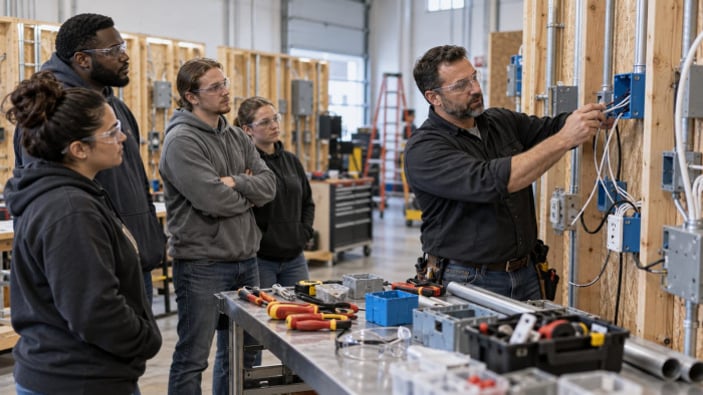
As an electrical instructor, you turn circuits, wiring methods, motors and controls, and blueprint reading into lessons, demonstrations and supervised lab practice. You assess projects, maintain student records and keep equipment ready for instruction. These duties apply the teaching tasks described by O*NET OnLine for postsecondary CTE teachers and secondary CTE teachers (accessed October 26, 2026) to an electrical career pathway.
| BLS occupation | National annual median pay | Source |
|---|---|---|
| Career/Technical Education Teachers, Secondary School | $66,270 | BLS Occupational Employment and Wage Statistics (OEWS), May 2025 |
| Career/Technical Education Teachers, Postsecondary | $63,820 | BLS OEWS, May 2025 |
What an electrical instructor does: the short answer
You plan a program of study, explain electrical concepts, demonstrate shop procedures and coach students as they practice. During lab time, observe electrical work, correct misunderstandings and check whether students can explain the circuit or wiring procedure they are practicing. Your primary workplace is an educational classroom, lab or shop in a high school CTE wing, district career center, regional technical center, or technical or community college.
BLS counts electrical instructors within Career/Technical Education Teachers, Secondary School and Career/Technical Education Teachers, Postsecondary. Neither occupation is electrical-only. When comparing openings, identify whether the electrical assignment serves a secondary career pathway or postsecondary courses before comparing responsibilities or pay.
Main duties
O*NET describes curriculum planning, instruction, equipment supervision, assessment and recordkeeping, which you carry out in an electrical classroom, lab and shop. In an electrical pathway, connect those responsibilities to the work students perform:
- Plan lessons and projects. Set clear objectives for circuits, wiring methods, motors and controls, and print reading. Prepare materials and connect classroom theory to shop assignments.
- Demonstrate and supervise. Explain wiring, testing and troubleshooting procedures, then observe students practicing. Enforce shop safety rules and supervise students around energized practice only under controlled lab procedures.
- Evaluate performance. Score written checks, performance tasks and lab projects. Give specific feedback, reteach difficult concepts and record grades, attendance and progress.
- Keep the shop ready. Select materials, maintain equipment and track inventory so demonstrations and student projects can proceed.
Pathway work also includes meeting with an advisory committee and industry partners, supporting work-based learning placements and advising a skilled-trades student organization. Your week can mix electrical classroom theory, lab demonstrations, shop supervision, grading and equipment upkeep.
For an interview, prepare an example connecting a circuit or wiring lesson objective, your demonstration and the student lab work you assessed. Ask how electrical industry partnerships and student-organization duties fit the opening.
Tools and technology
Your equipment responsibilities extend beyond demonstrating a task: O*NET identifies selecting instructional equipment, supervising its use, maintaining inventories and acquiring, maintaining or repairing laboratory equipment. For an electrical opening, ask the interviewer to describe the lab equipment, its condition and your responsibility for upkeep.
O*NET's postsecondary software list includes learning management systems, presentation software, office suites, spreadsheets and word processing software. Use those software categories to explain how you prepare electrical lessons and track lab work. Describe their instructional functions: organizing assignments, presenting a circuit explanation, recording project results or preparing written feedback.
In your application, describe how you organize electrical lab assignments and record feedback on circuit or wiring projects. Ask which instructional systems the department uses before preparing an electrical teaching demonstration.
Skills and knowledge the job uses
Instructing and learning strategies help you move from explaining a circuit to reteaching after a failed wiring attempt. Show how you adjust a demonstration, provide individual instruction or use a different explanation when students struggle.
Speaking, active listening, monitoring and critical thinking work together during lab instruction. You explain the task, listen to the student's reasoning, observe the work and decide what feedback or intervention is needed. Time management and coordination support equipment access, project preparation and collaboration with other instructors.
O*NET knowledge areas include education and training, building and construction, mechanical principles, and public safety and security, applied to circuits, materials and shop practice. English language knowledge supports explanations and feedback; customer and personal service knowledge supports communication with students and industry partners.
Prepare an example of how you taught a student to explain a circuit, check lab work or reason through a troubleshooting task.
Work settings and conditions
Expect electrical classroom instruction alongside lab or shop supervision, standing during demonstrations and close contact with students. O*NET reports that 41% of postsecondary CTE teacher respondents and 38% of secondary CTE teacher respondents spend about half their time standing. These figures describe the broader teaching occupations.
For noise, 33% of secondary CTE teacher respondents reported daily exposure to distracting or uncomfortable sounds. Ask how demonstrations remain audible, what protective gear the lab uses and how instructors supervise simultaneous student activities.
The school-year or term calendar also includes work beyond class: student-organization contests, advisory meetings and work-based learning visits. Secondary and postsecondary positions differ in student age, course scope and lab depth; examine the actual assignments.
During an interview, clarify time for electrical lab preparation, equipment upkeep and industry-partner visits outside class.
Pay at a glance
BLS reports the following national annual wages for the separate CTE teaching occupations. The percentiles describe the spread of annual pay across each broader CTE occupation.
| BLS occupation | Annual 10th percentile | Annual median | Annual 90th percentile |
|---|---|---|---|
| Career/Technical Education Teachers, Secondary School | $50,040 | $66,270 | $101,340 |
| Career/Technical Education Teachers, Postsecondary | $41,960 | $63,820 | $108,620 |
Source: BLS OEWS, May 2025. These are broad occupational benchmarks for wage-and-salary workers, with self-employed workers excluded.
When reviewing an electrical instructor posting, compare its teaching calendar, assigned courses, lab responsibilities and stated pay with the relevant occupation. Keep secondary and postsecondary benchmarks separate when discussing compensation.
Related roles
O*NET's reported titles include automotive instructor, HVAC-R instructor and welding instructor in postsecondary teaching, and CTE teacher, technology education teacher and welding instructor in secondary teaching. Check whether a general instructor title covers electrical courses, another trade or a mix of shop assignments.
If you are considering adjacent pathways, compare automotive technology instructor duties with your experience teaching troubleshooting. Reviewing welding instructor responsibilities and construction trades teacher duties can help you assess subject-specific fit. When weighing HVAC against electrical teaching, compare the technical content you can teach and the lab work you can supervise.
Use the CTE teacher résumé guide to connect your experience to lesson planning, assessment and shop supervision. Browse openings on ACTE Job Bank using both electrical instructor and broader CTE teaching titles.
Frequently asked questions
What does an electrical instructor do every day?
You prepare and teach electrical lessons, demonstrate procedures, supervise lab practice and assess student work. Grading, student records, individual help and equipment preparation also form part of the job.
Where does an electrical instructor work?
You may work in a high school CTE wing, district career center, regional technical center, or technical or community college lab. The primary workplace is an educational classroom or shop, with work-based learning visits supporting instruction.
What tools does an electrical instructor use?
You use instructional and shop equipment for demonstrations and student practice, with responsibility for supervising its use and care. O*NET also lists learning management systems, presentation software, spreadsheets and word processing software for postsecondary CTE teachers.
How much does an electrical instructor make?
BLS OEWS, May 2025, reports annual median pay of $66,270 for Career/Technical Education Teachers, Secondary School and $63,820 for Career/Technical Education Teachers, Postsecondary. Both categories include subjects beyond electrical instruction.
What jobs are similar to an electrical instructor?
Related teaching roles include HVAC instructor, welding instructor, automotive technology instructor and construction trades teacher. Compare the technical subjects, student projects and equipment-supervision duties before deciding which openings fit your experience.