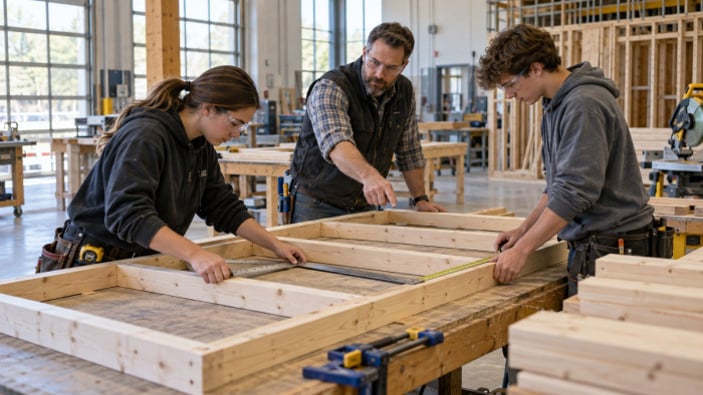
A construction trades teacher turns building knowledge into lessons, demonstrations and supervised shop projects. You teach safety, print reading, measuring, layout and building methods, then assess how students apply them. O*NET OnLine describes planning instruction, monitoring equipment use and evaluating student work for both secondary and postsecondary CTE teachers (accessed October 26, 2026).
| BLS occupation | National annual median pay | Source |
|---|---|---|
| Career/Technical Education Teachers, Secondary School | $66,270 | BLS Occupational Employment and Wage Statistics (OEWS), May 2025 |
| Career/Technical Education Teachers, Postsecondary | $63,820 | BLS OEWS, May 2025 |
What a construction trades teacher does: the short answer
You plan a construction program of study, explain building methods, demonstrate procedures and supervise students as they practice. Lessons connect classroom print reading and mathematics with hands-on work in carpentry, framing and finishing, masonry or related modules defined by the local career pathway.
Your primary workplace is a high school CTE shop, district career center, regional technical center or technical or community college construction lab. BLS counts construction trades teachers within Career/Technical Education Teachers, Secondary School and Career/Technical Education Teachers, Postsecondary. Neither category is construction-only.
When reviewing a posting, identify whether its construction projects emphasize carpentry, framing and finishing, masonry or another part of the pathway before choosing your teaching examples.
Main duties
For a construction project, O*NET's planning, instruction, assessment and equipment-care tasks connect the print-reading lesson to supervised building practice.
- Plan lessons and projects. Set objectives, prepare materials and explain how print reading, construction mathematics and shop practice connect. Define what students must demonstrate before you assign independent work.
- Demonstrate and supervise. Explain building methods, model equipment use and monitor students as they practice. Enforce shop procedures and correct unsafe use of tools or materials.
- Assess learning. Observe project work, administer written or performance tests and give feedback. Distinguish a finished project from evidence that the student understands the process.
- Keep the shop ready. Select, inventory, store and issue materials. Maintain equipment and tools, and coordinate upkeep with the next instructional activity.
- Document progress. Maintain grades, attendance and activity records. Use those records to identify students who need another demonstration or individual instruction.
Beyond class, pathway responsibilities may include advisory committee discussions, industry partner visits, work-based learning check-ins and sponsoring a skilled-trades student organization. Ask which responsibilities belong to the teaching position and how they connect to classroom projects.
A typical week mixes print-reading lessons, demonstrations, circulating among student projects, grading and equipment upkeep. For your résumé, adapt a task-based bullet such as: “Planned construction shop projects, demonstrated equipment procedures and assessed student performance against lesson objectives.” Use it only if it describes your work.
Tools and technology
Your equipment responsibilities extend beyond operating construction tools. O*NET emphasizes teaching students to use and care for equipment, supervising laboratory work, maintaining inventories and acquiring, maintaining or repairing laboratory equipment and tools.
For measuring, layout and building lessons, ask what equipment supports the actual projects in the program of study. Prepare to explain how you connect a project drawing to a shop demonstration, check understanding and supervise building practice.
O*NET's postsecondary software list includes learning management systems, presentation software, spreadsheets, word processing and office software. You can use those functions to distribute project instructions, illustrate a construction sequence, maintain grade records and prepare student feedback. For each software category on your résumé, explain its use in construction lessons, project assessment or shop records.
In an interview, describe how a construction drawing or classroom explanation supported your building-method demonstration and the project assessment that followed.
Skills and knowledge the job uses
Instructing and learning strategies mean breaking a building task into teachable steps and choosing between explanation, demonstration and guided practice. Speaking and active listening help you explain a sequence clearly and discover why a student has misread a print or misunderstood a procedure.
Monitoring, critical thinking and judgment come together while you circulate through the shop. You assess student progress, recognize an incorrect method and decide whether to intervene individually or pause the class for another demonstration. Time management and coordination connect materials preparation, shared equipment, project work and feedback.
The knowledge behind that teaching combines education and training with building and construction, design, mechanical concepts, mathematics and public safety. English language supports clear instructions and feedback; customer and personal service supports communication with students and industry partners.
For your application, pair each skill with a construction teaching example. Use the construction trades teacher interview questions to practice explaining your decisions during shop instruction and project assessment.
Work settings and conditions
The job moves between classroom explanation and lab or shop supervision. Secondary settings serve high school students; postsecondary instruction primarily serves students who have graduated from or left high school. Ask how project depth, independent work and instructional support differ in the position you are considering.
O*NET reports that 38% of secondary CTE teacher respondents and 41% of postsecondary respondents spend about half their time standing. For secondary teachers, 33% reported daily exposure to distracting or uncomfortable noise. These figures describe the broader CTE occupations.
Ask how the construction shop handles dust, protective gear and supervision around equipment. Outdoor practice on mock-ups or school projects may be part of the local program of study.
Review the school-year or term calendar alongside student-organization contests, advisory meetings and work-based learning check-ins outside class. Ask how those duties fit around construction project preparation, grading and shop upkeep.
Pay at a glance
BLS reports separate pay distributions for secondary and postsecondary CTE teachers. The percentiles describe the spread of annual pay across each broader CTE occupation.
| Annual pay measure | Career/Technical Education Teachers, Secondary School | Career/Technical Education Teachers, Postsecondary |
|---|---|---|
| 10th percentile | $50,040 | $41,960 |
| 25th percentile | $60,590 | $50,320 |
| Median | $66,270 | $63,820 |
| 75th percentile | $80,060 | $82,360 |
| 90th percentile | $101,340 | $108,620 |
Source: BLS OEWS, May 2025. Compare a posting with the relevant educational setting, then examine its teaching assignment, shop responsibilities and calendar. Keep the broader occupational figures separate from the compensation attached to a particular construction teaching position.
Related roles
O*NET's sample titles include CTE teacher, vocational teacher, instructor and welding instructor. Search by both teaching title and construction pathway because a general instructor title may reveal its subject only in the duties.
When comparing adjacent pathways, the welding instructor duties guide and electrical instructor duties guide can help you examine subject-specific teaching responsibilities. Use the broader CTE teacher duties guide to compare responsibilities that extend across pathways.
As you browse openings on ACTE Job Bank, compare construction content, student group, shop supervision and work-based learning duties. Choose résumé examples that connect construction content with student projects, shop supervision or work-based learning.
Frequently asked questions
What does a construction trades teacher do every day?
You prepare lessons, explain construction concepts, demonstrate procedures and supervise student shop work. You also assess projects, give feedback, maintain student records and prepare equipment and materials for instruction.
Where does a construction trades teacher work?
You may work in a high school CTE shop, district career center, regional technical center or technical or community college construction lab. Classroom instruction and supervised shop projects form the core setting.
What tools does a construction trades teacher use?
You teach with construction shop tools and laboratory equipment selected for the local program of study. O*NET also lists learning management systems, presentation software, spreadsheets and word processing for postsecondary CTE teachers.
How much does a construction trades teacher make?
BLS OEWS, May 2025, reports annual median pay of $66,270 for Career/Technical Education Teachers, Secondary School and $63,820 for Career/Technical Education Teachers, Postsecondary. Both occupations include subjects beyond construction.
What jobs are similar to a construction trades teacher?
Related teaching roles include welding instructor, electrical instructor, general CTE teacher and technical college instructor. Compare the subject matter, student group and equipment supervision duties before deciding which assignments match your experience.