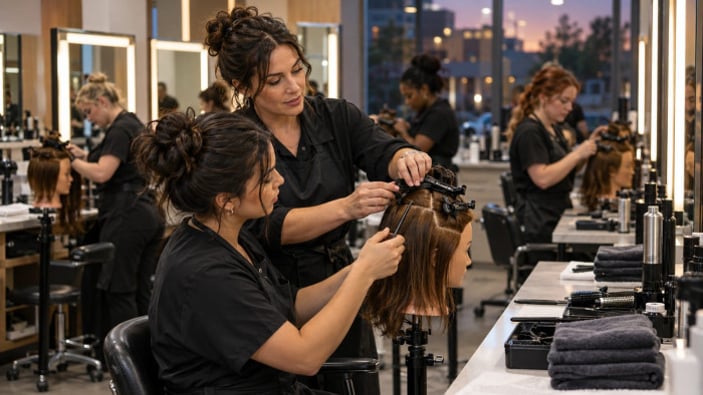
Working as a cosmetology instructor means demonstrating services, supervising practice and assessing students while keeping a salon lab running. Contact with people is central: O*NET OnLine’s postsecondary CTE profile reports 68% constant contact with others; its secondary CTE profile reports 82% constant contact (both accessed October 26, 2026). Your schedule combines instruction, clinic supervision and work beyond class.
| Occupation | Work-context facts | Source |
|---|---|---|
| Career/Technical Education Teachers, Postsecondary | 68% reported constant contact with others; 41% reported standing about half the time. | O*NET OnLine, accessed October 26, 2026 |
| Career/Technical Education Teachers, Secondary School | 82% reported constant contact with others; 38% reported standing about half the time. | O*NET OnLine, accessed October 26, 2026 |
What it is like to work as a cosmetology instructor: the short answer
You alternate between explaining a technique, demonstrating it, watching students practice and deciding when to intervene. On a clinic floor, you also attend to guest comfort, sanitation and the progress of services. The rhythm follows a school year or academic term, with preparation and student activities extending beyond lecture.
BLS counts cosmetology instructors within Career/Technical Education Teachers, Postsecondary (25-1194) and Career/Technical Education Teachers, Secondary School (25-2032). These are the broader categories used in BLS Occupational Employment and Wage Statistics (OEWS), May 2025.
When comparing cosmetology assignments, check whether the duties center on a secondary lab, technical-college classroom or public-facing student salon. Use the cosmetology instructor salary guide alongside the position’s actual classroom and clinic responsibilities.
A typical day
Your preparation connects each lesson to the cosmetology career pathway: hair, skin, nails or salon operations. You establish the objective, prepare materials and organize a demonstration students can follow. O*NET identifies lesson planning, demonstrations, equipment supervision and individual instruction among tasks for both occupations that include cosmetology instructors.
During practice, you circulate between stations, check technique and enforce sanitation and safety procedures. A student who can explain a hair, skin or nail service may still need coaching at the chair during a live guest service. You assess practical work, guest services and written checks, then record progress through the program of study.
Outside instruction, advisory-committee discussions and industry-partner contact help you connect classroom expectations with salon practice and work-based learning. For an interview, describe a cosmetology service you demonstrated, the student technique you observed and the feedback you gave before reassessing the practical work.
Settings
You may work in a high school cosmetology lab, a career center or a technical-college clinic. The assignment can span a theory classroom, station-based practice and a student salon that serves the public. Read the posting for the balance between classroom instruction and guest-facing supervision.
A salon lab brings product odor, equipment noise and close work around occupied stations. When guests are present, instruction must fit the service underway: you explain a correction clearly while helping the student maintain a professional interaction.
Ask to see how the theory classroom, practice stations and guest-service areas are arranged during the interview process. The broader CTE teacher work-environment guide can help you compare the classroom, lab and student-activity responsibilities attached to a secondary assignment.
Secondary labs and technical-college clinic floors
Secondary instruction follows a school-year program of study with minors in the lab. Alongside technical demonstrations, you manage student behavior, communicate progress to families and coordinate with other educators. O*NET specifically includes those duties in the secondary occupation.
Technical-college instruction centers on courses and academic terms, with adult students and clinic blocks that may include evenings. Guest appointments can shape the sequence of demonstrations, student services and practical assessments. Both settings combine demonstration, sanitation and live practice.
Compare how secondary lab lessons or technical-college clinic blocks fit around guest services, demonstrations and practical assessments. The comparison of CTE teachers and technical college instructors offers another way to organize questions about the role.
Physical and safety demands
Expect standing, moving between stations and repeated hand and arm movements during demonstrations. O*NET’s standing responses cover the broader CTE teaching occupations; a cosmetology assignment’s particular mix depends on its lecture, lab and clinic duties. Close supervision also means working within reach of students and guests.
Salon instruction involves products and chemicals, equipment noise and detailed work around a guest’s eyes and scalp. You supervise technique while monitoring product handling, sanitation and protective gear appropriate to the activity. These responsibilities continue while other students need feedback elsewhere in the room.
Ask how the clinic organizes supervision, materials and equipment care. In your interview, describe how you notice an unsafe step, pause the activity and explain the correction while maintaining control of the lab.
Schedule and time outside class
Your calendar may include daytime labs, academic-term courses and clinic blocks organized around guest appointments. Public clinic days can stretch around guest flow and the time a service needs to finish. Ask how the timetable accounts for guest appointments and clinic supervision.
O*NET reports that 80% of respondents in the broader secondary CTE occupation described a typical workweek of more than 40 hours. Confirm how clinic, preparation and student-organization time sit beside classroom blocks in the assignment you want. Student-organization events, advisory meetings and work-based learning check-ins can sit outside classroom instruction.
Request the expected cosmetology teaching blocks, clinic supervision, service preparation and student-organization duties when discussing a position. As you browse ACTE Job Bank openings, compare those details across postings instead of treating scheduled class time as the entire assignment.
People you work with
Students at the stations need demonstrations, feedback and clear expectations. Fellow CTE teachers and clinic aides help you coordinate instruction on the clinic floor. On the secondary side, families, counselors and administrators also participate in discussions about student progress.
Guests bring another relationship into the lesson. You help students explain services, respond to concerns and accept correction professionally. Industry partners and advisory-committee participants connect your teaching with workplace expectations.
Prepare an interview example involving a student, a guest and a teaching decision. Show how you explained the next step to each person and documented the student’s progress afterward.
Who tends to enjoy this work
You may enjoy this role if teaching a personal-care trade appeals to both your social interests and your preference for practical work. O*NET lists coaching, organizing instruction and evaluating student performance as work activities in these occupations. Enjoying the service itself is only part of the fit; you also need to enjoy watching someone learn it.
Dependability means having the lab ready and following through on feedback. Concern for others appears in attention to guest comfort. Attention to detail means checking sanitation and technique, while self-control helps you correct a student calmly in front of a guest.
For your résumé, describe a salon-lab assessment or a correction you made during a student service, including how you adapted instruction after observing a difficulty.
Frequently asked questions
What are the hours like for a cosmetology instructor?
Schedules follow school-year or academic-term teaching, with clinic blocks, preparation and student activities. O*NET reports that 80% of respondents in the broader secondary CTE occupation described workweeks of more than 40 hours; ask about the specific cosmetology assignment’s timetable.
Is being a cosmetology instructor physically demanding?
The work includes standing, repeated hand and arm movements and close supervision around guests. In O*NET’s broader postsecondary CTE occupation, 41% reported standing about half the time; salon-lab duties also involve products, chemicals and equipment noise.
Where do cosmetology instructors work?
You can work in high school and career-center labs or technical-college classrooms and clinic floors. Some assignments include a student salon serving the public.
Who do you work with day to day in a cosmetology program?
You work with students, fellow CTE teachers, clinic aides and salon guests. Secondary assignments also involve families, while advisory committees and industry partners connect instruction with workplace practice.
What kind of person enjoys cosmetology instruction?
You may enjoy it if you like demonstrating personal-care techniques, coaching students and assessing their progress. Dependability, attention to detail, concern for guest comfort and calm correction all have practical value on the clinic floor.