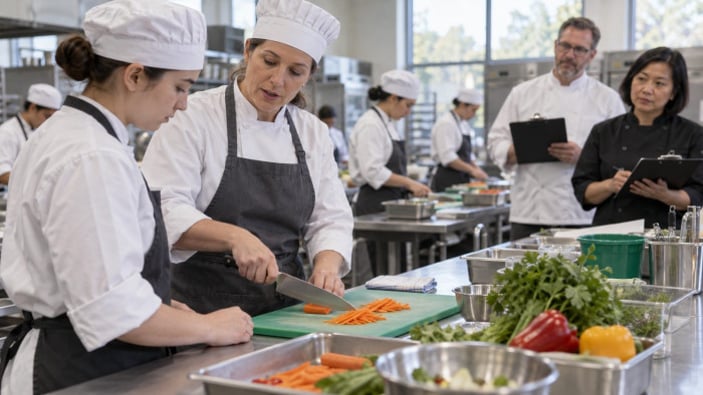
A kitchen resume cannot show whether a culinary arts instructor can teach knife skills and station flow while running a student kitchen safely. BLS counts culinary arts instructors within Career/Technical Education Teachers, Postsecondary. Per BLS Occupational Employment and Wage Statistics (OEWS), May 2025, that occupation employed 114,110 workers at a median annual wage of $63,820. Use a timed production check, a teaching demonstration, and a kitchen-safety scenario for every candidate.
| Fact | Figure | Source |
|---|---|---|
| Occupation | Career/Technical Education Teachers, Postsecondary (BLS; includes culinary arts instructors at technical colleges and career centers) | BLS OEWS, May 2025 |
| U.S. employment | 114,110 | BLS OEWS, May 2025 |
| Median wage | $63,820 a year; $30.68 an hour | BLS OEWS, May 2025 |
| Annual wage spread (10th, 25th, median, 75th, 90th percentiles) | $41,960; $50,320; $63,820; $82,360; $108,620 | BLS OEWS, May 2025 |
What to screen culinary arts instructor candidates for
Test the skills the job uses every lab period, not the polish of a resume. O*NET OnLine (accessed September 25, 2026) lists instructing, speaking, and active listening as essential skills for Career/Technical Education Teachers, Postsecondary, with learning strategies, monitoring, time management, and critical thinking close behind. In a culinary program of study those skills look like a clear demo, coaching at the bench, watching every station, and finishing the period on time.
O*NET tasks for this occupation include observing and evaluating students' work, supervising and monitoring students' use of tools and equipment, administering performance tests, providing individualized instruction, preparing records such as grades and training activity details, developing curricula, and supervising laboratory work. Treat those tasks as the work sample. The same occupation-level method is laid out for other CTE labs in the guide to screening CTE teacher candidates with skills and work-sample tests.
Build the screen in three parts: technical kitchen skill, teaching skill, and kitchen-safety judgment. A candidate who can plate under restaurant pressure may still lecture through a lab, skip the safety briefing, or leave a dirty station for the next class. Score all three parts before you talk about fit.
Technical skill check
Run a timed production work sample in the program kitchen, on the same range, boards, and smallwares students will use. Hand the candidate a written spec: specified knife cuts (julienne, brunoise, and small dice) and one cooked item, with mise en place, a tasting for the panel, and a full station reset. Do not substitute a plated special the candidate chooses; the spec is the assignment.
Watch the work, not the story. Score knife grip and cut consistency, sanitation between raw and ready-to-eat, heat control, seasoning to the written spec, pacing against the clock, and whether the station is left clean for the next class. O*NET work activities for this occupation include inspecting equipment, materials, and surroundings, handling and moving objects, and monitoring processes. Those show up as a candidate who checks the range, keeps raw protein off ready-to-eat boards, and resets the line without being asked.
Add a short paper task that matches the O*NET work activities of documenting and recording information and analyzing data. Give a yield and an ingredient list and ask the candidate to cost the recipe, or ask for a job sheet for one lab period that sequences demo, student practice, tasting, and cleanup. If the costing task uses a spreadsheet, use software O*NET already names for this occupation, such as Microsoft Excel. Keep the paper task short, job-related, and scored on accuracy and whether a student could follow the job sheet.
Write the production spec and the paper prompt into the posting so candidates know they will cook and teach, not only interview. Put the same packet on the station for every person you screen.
Teaching demonstration
A kitchen that runs well under the candidate is not the same as a kitchen students can learn in. Ask for a short teaching demonstration of one hands-on skill: a knife cut, a mother sauce, a cooking method, or station setup. The candidate delivers it to the panel as if they were students in the career pathway, including the safety briefing for knives, open flame, steam, and slips.
O*NET describes conducting training sessions to teach and demonstrate principles, techniques, procedures, or methods; applying multiple teaching methods; and coaching and developing others. Score clarity of the demo, whether the candidate checks for understanding, pacing that leaves time for practice, and whether students would get repetitions at the bench rather than a lecture. A candidate who talks through a sauce and never puts a pan on the fire is not teaching the lab you run.
Keep the skill small enough that the panel can watch the full cycle: safety briefing, demonstration, guided practice, and a check of student work. After the demo, use the same job-related culinary arts instructor interview questions with every finalist so the conversation matches the work sample.
Safety and kitchen management judgment
Give a short oral scenario. A student uses a knife unsafely. A pan of oil overheats. Ready-to-eat food is prepped on a board that just held raw protein. Ask the candidate to walk through the response as if class is in session.
O*NET work activities include evaluating information to determine compliance with standards, making decisions and solving problems, and supervising laboratory work. A strong answer stops the work, makes the station safe, reteaches the procedure to the class, and resets kitchen rules without humiliating the student. A weak answer yells, ignores the rest of the lab, or treats the incident as a one-student problem instead of a class procedure.
Listen for how the candidate would document the incident and follow up in the next lab period. Preparing reports and maintaining training records is an O*NET task for this occupation; a culinary instructor who cannot describe that follow-through will struggle with your program's recordkeeping.
Building a fair scoring rubric
Use the same recipe or cut list, the same time limit, the same equipment, and the same rubric for every culinary arts instructor candidate. Change none of those between morning and afternoon screens. Panel members should include the program chair, a veteran culinary instructor, and a member of the industry advisory committee. Each person scores independently before anyone discusses the candidate.
| Part | What the panel scores | Meets the bar |
|---|---|---|
| Timed production | Knife cuts to spec (julienne, brunoise, small dice); cooked item; sanitation; heat and seasoning; station reset | Spec met; raw and ready-to-eat kept apart; station ready for the next class |
| Paper task | Recipe cost from a given yield, or a lab job sheet | Figures or steps a student and an instructor could follow |
| Teaching demonstration | Safety briefing; clarity; checks for understanding; bench practice versus lecture | Students would cook, not only listen |
| Safety scenario | Stop work; make the station safe; reteach; reset rules without humiliating the student | Class stays safe and the procedure is taught again |
Ask every candidate the same job-related questions. Do not ask about age, family or pregnancy, religion, national origin, disability, genetic information, or other protected characteristics. The U.S. Equal Employment Opportunity Commission (accessed September 25, 2026) states that it is illegal to discriminate because of race, color, religion, sex (including transgender status, sexual orientation, and pregnancy), national origin, age (40 or older), disability, or genetic information, and that any test required of applicants must be necessary and related to the job. This guide is general information as of September 25, 2026, not legal advice.
Putting the screen into your hiring process
Run the screen in this order: application review, a short phone screen, the skills check plus teaching demonstration, interview, then references. Use BLS figures for Career/Technical Education Teachers, Postsecondary as the market reference when you set the range: median annual pay $63,820, with the 10th percentile at $41,960 and the 90th at $108,620.
Write the work sample into the posting copied from your culinary arts instructor job description template, then post the opening. Name the kitchen, the equipment, and that candidates will complete a timed production sample and a teaching demonstration. Verify any license or credential the candidate lists with the body that issues it before the start date, and follow your district's or college's own clearance process.
Run the same screen for part-time candidates who still work in industry. Use the same student kitchen and the same equipment. Restaurant speed does not prove a person can teach a career pathway lab, keep an advisory committee's specs in the curriculum, or supervise work-based learning students on a station. For the full hiring sequence around this screen, see how to hire a culinary arts instructor.
More hiring guides
FAQ
How do I test a culinary arts instructor before hiring?
Run a timed production work sample in your student kitchen, a short teaching demonstration of one hands-on skill, and a kitchen-safety scenario. Score technical skill, teaching skill, and safety judgment with the same rubric for every candidate.
What should a culinary teaching demonstration include?
Include one hands-on skill (a knife cut, a mother sauce, a cooking method, or station setup), delivered as if the panel were students, plus a safety briefing for knives, open flame, steam, and slips. Score clarity, checks for understanding, pacing, and whether students would get repetitions at the bench rather than a lecture.
How long should a culinary skills test take?
Set one clock that covers mise en place, the listed knife cuts, one cooked item, tasting, and a full station reset, then add the teaching demonstration and a short written task in the same visit. Use that same limit for every candidate.
How do I score a timed kitchen work sample fairly?
Give every candidate the same recipe or cut list, time limit, equipment, and rubric. Have the program chair, a veteran culinary instructor, and an industry advisory member score independently before they discuss.
Should part-time industry candidates take the same test?
Yes. Run the same production sample, demonstration, and safety scenario in the same student kitchen on the same equipment, so industry line speed is not mistaken for the ability to teach and supervise a lab.