A conversation will not tell you whether a candidate can teach a salon skill, brief sanitation, and supervise a student clinic. Screen every applicant with the same timed lab demo. BLS Occupational Employment and Wage Statistics (OEWS), May 2025 does not publish a separate cosmetology-instructor occupation; these instructors are counted within Career/Technical Education Teachers, Postsecondary (114,110 wage-and-salary workers) and Career/Technical Education Teachers, Secondary School (111,420).
| Item | Figure | Source |
|---|---|---|
| U.S. employment, Career/Technical Education Teachers, Postsecondary (BLS; includes cosmetology instructors) | 114,110 | BLS OEWS, May 2025 |
| U.S. employment, Career/Technical Education Teachers, Secondary School (BLS; includes cosmetology instructors) | 111,420 | BLS OEWS, May 2025 |
| Sample reported titles | Cosmetology Instructor; Cosmetology Teacher | O*NET OnLine, accessed September 25, 2026 |
Screening cosmetology instructor candidates: the short answer
Hire on a work sample that mirrors the job, not on a conversation. Have the candidate teach one hands-on salon skill, brief sanitation and chemical safety before tools come out, and supervise a student the way they would in clinic. A slide-deck sample lesson never touches a station, so it will not show you the work.
Build the screen from O*NET OnLine tasks for Career/Technical Education Teachers, Postsecondary (SOC 25-1194) and Career/Technical Education Teachers, Secondary School (SOC 25-2032), accessed September 25, 2026. Applied to a cosmetology program of study, those tasks are: present and demonstrate; supervise use of tools and equipment; observe and evaluate student work; give feedback; administer a performance task; and keep the lab running. Use the same task, time limit, and rubric for every candidate, and never judge on age or other protected traits. The lab-demo method used when screening CTE teacher candidates applies here; the content is your salon pathway.
Name the skills-lab sample in the posting so applicants arrive ready to teach at a station.
What you are screening for in this pathway
The instructor must be both a working expert in the salon services your program of study actually teaches—hair, skin, or nails—and a teacher of secondary or postsecondary students in a salon-style lab. Many career centers and technical colleges run a student clinic that serves real clients as work-based learning. That clinic is the live lab.
Test O*NET-aligned duties in that setting: demonstrate a skill; supervise stations and equipment; evaluate a live performance; give individualized feedback; keep records of a performance task; and integrate the skill with the rest of the program of study. Typical settings are high school CTE labs, career centers, and technical-college salon clinics, with industry partners on the advisory committee. If the seat is postsecondary, pair this screen with your process for how to hire a technical college instructor.
Write the posting around clinic supervision and lab teaching, not around chair volume.
Skills, tools and work context to put on the rubric
Score skills O*NET lists that show up in a short lab demo: instructing, speaking, active listening, learning strategies, monitoring, time management, and coordination. You will see all of them if the candidate has to teach, listen to a student, watch a station, and finish on time.
Use classroom tools from the O*NET lists—computers, projectors, audio-visual aids, and presentation software such as Microsoft PowerPoint, plus course tools such as Google Classroom or a learning management system—only as support. The pathway equipment the candidate will actually teach with should be yours: styling stations, mannequins, thermal tools, color bowls and brushes, sanitation jars, and dispensary products already in the lab. Do not ask candidates to bring a full kit; the test is teaching on your floor.
Watch face-to-face teaching, standing at the station, exact sanitation steps, time pressure, contact with others, and external customers when the sample includes a clinic-client moment. For postsecondary CTE teachers, O*NET reports 68% of respondents in constant contact with others, 54% in face-to-face discussions every day, 44% who say being exact or accurate is extremely important, 41% who spend about half the time standing, 42% who report time pressure once a week or more, and 42% who say dealing with external customers is extremely important. For secondary CTE teachers, 82% reported constant contact with others, 64% reported time pressure once a week or more, and 39% reported very high responsibility for the health and safety of other workers.
Put those skills and that work context on the rubric so every rater scores the same behaviors.
Work sample 1: teaching demonstration of a salon skill
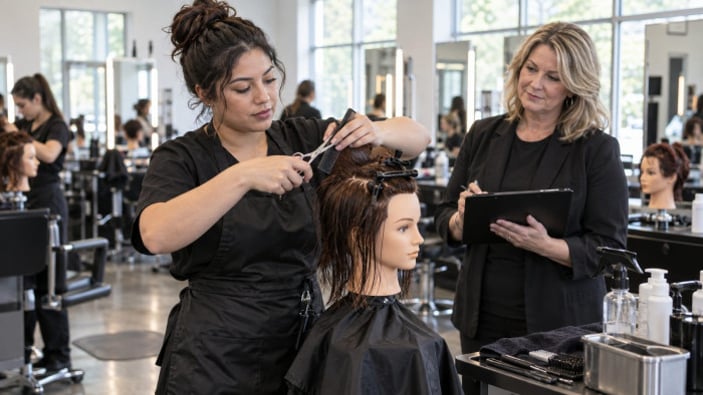
Give the candidate 10–15 minutes to teach the panel (as students) one discrete skill from your program of study: a basic cut on a mannequin, a blow-dry set, a manicure step, or a color-mixing walkthrough using non-service products already in your dispensary. As when screening culinary arts instructor candidates, the point is teaching and supervision, not a speed test of the candidate’s own chair work. Do not ask for a full client service or a live chemical service on a person.
| Step | Time | What you provide | What the candidate does |
|---|---|---|---|
| Sanitation and chemical-safety briefing | 2–3 minutes | Station already set; listed products only | Briefs disinfection, tool handling, and product safety before tools come out |
| Demonstration | 6–8 minutes | Mannequin and the tools named in the prompt | Teaches one discrete skill to the panel as students |
| Student check and re-teach plan | 2–4 minutes | Same station | Checks understanding and says how extra reps will run for students who need them |
Require the sanitation briefing before tools come out, then the demonstration, then a check for student understanding. Advance people who can teach the skill and still leave time for practice, not people who only perform it.
Work sample 2: student clinic and lab supervision
Give 5–10 minutes for a clinic-floor sample. A panelist or current student plays a student at a station. The candidate watches a short performance, stops unsafe or unsanitary work, and gives feedback the way they would on the clinic floor.
Add one client-recovery prompt: a clinic client is unhappy with a student service. Score how the instructor coaches the student and recovers the client without taking the station over as a stylist. Watch monitoring, feedback, sanitation, and whether the candidate still treats the moment as teaching rather than doing the work themselves.
Use this sample to see clinic judgment you will need in the first weeks, when student clinic is live and industry partners are sending clients through the door.
Optional planning sample
Ask for a one-page plan for a single lab block in the program of study: objective, demonstration, supervised practice, performance-task check, and how early finishers and struggling students are handled. Look for integration of academic and technical practice—measuring, angles, or product chemistry spoken in student language—not a lecture outline with no lab time.
Keep this sample short so it does not replace the hands-on tests. Use it only to see whether the candidate can sequence a lab block before you put them on the clinic schedule.
Scoring and running the screen fairly
Use a simple rubric with the same categories for every candidate: demonstration quality, sanitation and chemical-safety briefing, student checks, feedback, lab supervision, and time management. Give the same mannequin, station, products, and time limit.
| Category | Meets the bar | Does not meet |
|---|---|---|
| Demonstration quality | Names steps, shows the skill on the mannequin, checks student view | Skips steps, blocks the station, or talks over the work |
| Sanitation and chemical-safety briefing | Briefs before tools come out; covers disinfection and product handling | Starts with tools; skips contamination or chemical handling |
| Student checks | Asks a check for understanding and names a re-teach plan | Lectures only; no check; no plan for extra reps |
| Feedback | Specific, timely, and tied to the performance just seen | Vague praise, or taking over the work |
| Lab supervision | Stops unsafe or unsanitary work; keeps the moment as teaching | Ignores hazards or completes the service themselves |
| Time management | Fits the 10–15 minute window and closes the lesson | Runs long or never reaches practice |
When you post the opening, state that a skills-lab work sample is part of screening. Keep interview questions job-related. The U.S. Equal Employment Opportunity Commission states that it is illegal to discriminate because of race, color, religion, sex (including transgender status, sexual orientation, and pregnancy), national origin, age (40 or older), disability, or genetic information, and that if you require a test, the test must be necessary and related to the job (accessed September 25, 2026). Never ask about age, family or pregnancy, religion, national origin, disability, genetic information, or other protected characteristics. Keep notes on the teaching you saw, not on personal history. If the candidate lists a license or professional credential, verify it directly with the body that issues it before the start date. This guide is general information as of September 25, 2026, not legal advice.
After the skills tests
Advance candidates who can teach and supervise, not only those who are strong behind the chair. A great stylist who cannot brief safety or give feedback is not yet an instructor.
Use the interview to press on advisory-committee work, student organization advising, and work-based learning with salon or spa partners, including student clinic as the live client lab. Job-related career and technical education teacher interview questions belong after the lab samples, not instead of them. Reference calls should ask about lab or clinic teaching, sanitation habits, and reliability with colleagues and clients. Then put duties, clinic schedule, and pay in writing.
FAQ
How do I test a cosmetology instructor candidate?
Run a 10–15 minute teaching demonstration of one salon skill plus a 5–10 minute student-clinic supervision sample. Score sanitation, demonstration, feedback, and whether the candidate teaches rather than taking over the station.
What work sample should I use for a cosmetology instructor?
Use a timed teaching demo of one discrete skill from your program of study—a basic cut on a mannequin, a blow-dry set, a manicure step, or color-mixing with non-service products—plus a clinic-supervision moment with a client-recovery prompt.
How do I score a cosmetology teaching demonstration?
Use the same rubric for every candidate: demonstration quality, sanitation and chemical-safety briefing, student checks, feedback, lab supervision, and time management. Give the same mannequin, station, products, and time limit.
What skills should I screen for in a cosmetology instructor?
Screen for the O*NET skills that show up in a short lab demo: instructing, speaking, active listening, learning strategies, monitoring, time management, and coordination, plus sanitation and clinic supervision.
How do I run a salon-lab skills test fairly?
Give every candidate the same task, time, station, and products, and keep questions job-related. Under EEOC rules, do not judge on race, color, religion, sex, national origin, age, disability, or genetic information; 68% of postsecondary CTE teacher respondents on O*NET reported constant contact with others, so score the teaching you see in that contact, not personal history.