Hire a culinary arts instructor by defining kitchen production and teaching duties, setting pay from BLS Occupational Employment and Wage Statistics (OEWS), May 2025, and testing real cooking and instruction. BLS counts culinary teachers within Career/Technical Education Teachers. Secondary CTE teachers (SOC 25-2032) number 111,420 with a median of $66,270; postsecondary CTE teachers (SOC 25-1194) number 114,110 with a median of $63,820.
| Fact | Figure | Source |
|---|---|---|
| Secondary CTE teachers, annual median | $66,270 | BLS OEWS, May 2025 |
| Postsecondary CTE teachers, annual median (hourly median $30.68) | $63,820 | BLS OEWS, May 2025 |
How to hire a culinary arts instructor: the short answer
Write the job around the program of study you actually run, then set pay from BLS for the matching CTE teaching occupation. Screen for kitchen command and the ability to teach while production is moving. Finish with references who have watched the person train cooks or run a teaching kitchen, and put schedule, duties, and pay in the offer letter.
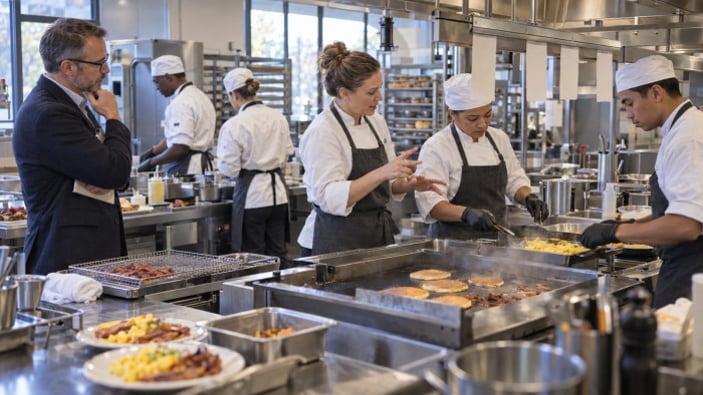
This hire is not a lecture-hall teaching job. The instructor runs a working commercial kitchen as a classroom, teaching knife skills, cooking methods, sanitation, and kitchen management, often while producing food for a student-run restaurant or catering service. Timing, yield, student coaching, and safe equipment use happen in the same block.
What a culinary arts instructor does
Typical employers are high school career centers, technical and community colleges, and culinary programs. A secondary opening sits next to other shop teachers in a career center; a college opening sits on a faculty line with lab sections, often including evening service. For a broader secondary search, see how to hire a career and technical education teacher; for a college lab line, see how to hire a technical college instructor.
According to O*NET OnLine for secondary CTE teachers (accessed September 24, 2026), core work includes instructing students individually and in groups with lectures, discussions, and demonstrations; teaching occupational skills through laboratory and shop study; and instructing and monitoring students in the use and care of equipment and materials to prevent injury and damage.
O*NET OnLine for postsecondary CTE teachers (accessed September 24, 2026) adds observing and evaluating student work, supervising laboratory work, conducting sessions that demonstrate techniques and procedures, and acquiring, maintaining, and repairing laboratory equipment and tools. Faculty also develop curricula, select and assemble supplies, and advise students on career decisions.
In a culinary program of study those tasks look like this: teach cooking techniques, baking, knife skills, and kitchen sanitation; run production in the teaching kitchen or student-run restaurant; teach menu planning, food-costing concepts, and front-of-house service; order supplies; and keep ovens, ranges, mixers, and smallwares in working order. The kitchen follows the employer's own food-safety procedures. Industry partners on the advisory committee and work-based learning sites are part of the instructional design, not extras.
Skills, knowledge and tools to look for
Look for someone who can teach a method, then watch a class execute it without losing control of heat, time, or sanitation. O*NET work activities that travel well into a culinary lab include training and teaching others, coaching and developing others, coordinating the work of others, monitoring processes and materials, inspecting equipment, monitoring and controlling resources, and evaluating whether work meets a standard. Postsecondary CTE teaching lists active listening and learning strategies among essential skills on O*NET.
Treat these as must-haves on day one: clean knife work, the ability to demonstrate a technique and then monitor students using equipment, sanitation habits that match your kitchen's procedures, production timing, and inventory discipline. You can train after hire: your LMS, grading conventions, recordkeeping, advisory committee cadence, and how you advise a student organization.
Setting the pay range
Use BLS figures as the market reference for the range. BLS publishes annual wages only for secondary CTE teachers. Postsecondary CTE teachers also have an hourly median of $30.68 and an hourly mean of $34.64. Percentiles below show the spread of pay across each occupation, not labels for a career stage.
| Measure | Secondary CTE teachers (SOC 25-2032) | Postsecondary CTE teachers (SOC 25-1194) |
|---|---|---|
| Employment | 111,420 | 114,110 |
| Annual mean | $72,680 | $72,060 |
| Annual median | $66,270 | $63,820 |
Match the code to the setting: SOC 25-2032 for a high school or career-center shop, SOC 25-1194 for a technical or community college. Then read the BLS state row for where the job sits. A location quotient above 1 means the occupation is more concentrated in that area's employment than nationally. Secondary CTE teachers in Texas show employment of 32,250 and a location quotient of 3.2 with an annual median of $64,610. Washington's secondary annual median is $101,180 (employment 3,460, location quotient 1.36). For postsecondary CTE teachers, Wisconsin's annual median is $82,620 (hourly median $39.72); Alaska's location quotient is 4.7 with an annual median of $77,310.
| Rank | State | Occupation | Employment | Annual median | Location quotient |
|---|---|---|---|---|---|
| 1 | Washington | Secondary (25-2032) | 3,460 | $101,180 | 1.36 |
| 1 | Wisconsin | Postsecondary (25-1194) | 2,000 | $82,620 | 0.93 |
Place the offer by the published spread, your state's median, and the scope of duties (restaurant production, catering, dual enrollment, evening service). Do not invent a separate adjunct or per-course rate from these tables; BLS does not publish those figures here.
Writing the posting and finding candidates
Title the job Culinary Arts Instructor when that is the program, and describe the kitchen, not a generic classroom. Start from a culinary arts instructor job description template and rewrite it to your pathway, student groups, and production calendar. State the setting, the weekly schedule, service nights, catering, student organization advising, and advisory committee work in plain language.
Look past current teachers. Restaurant and catering leads who have trained cooks already practice instructing, coordination, and monitoring. Say whether the hire will run a student-run restaurant, a catering calendar, or daytime labs only. Post where career and technical educators look, including the ACTE Job Bank. Same-lab hires in other pathways, such as how to hire a health science teacher, follow the same rule: the posting should read like the shop.
Screening and interviewing
Bring finalists into your teaching kitchen. Run one work sample: a cooking demonstration of one technique with a mini-lesson on sanitation, then a quick critique of a sample plate. Score the same dimensions for every candidate.
| Work-sample dimension | What to watch | Score (1–4) |
|---|---|---|
| Technique demonstration | Clear method, correct tool use, plate that matches the lesson | |
| Teaching while cooking | States the objective, checks for understanding, adjusts pace | |
| Sanitation and student safety | Talks through your kitchen's procedures; monitors hands, tools, and traffic |
Keep the interview on the job. Ask every candidate the same questions.
| Theme | Sample question |
|---|---|
| Professional kitchen experience | Walk us through a service where you trained others while tickets were in the window. What did you hold back for later teaching? |
| Kitchen safety and sanitation with students | A student skips a step in your kitchen's food-safety procedures during lab. What do you do in the next two minutes, and what do you teach the next day? |
Questions must be job-related. Under the laws enforced by the U.S. Equal Employment Opportunity Commission (accessed September 24, 2026), it is illegal to discriminate because of race, color, religion, sex (including transgender status, sexual orientation, and pregnancy), national origin, age (40 or older), disability, or genetic information. Do not ask about those subjects, family plans, or similar personal matters. If you use a work sample, it must be necessary and related to the job.
References, verification and the offer
Call people who have seen the candidate run a line, a banquet, or a teaching kitchen. Ask about kitchen leadership, sanitation habits, and experience training cooks. Ask how the person handled a missed ticket, a broken piece of equipment, or a student who was unsafe with a knife.
Verify any degree, license, or credential the candidate lists with the body that issued it, and complete that check before the start date. Follow your district's or college's own clearance process. Put duties, schedule (including service nights), production expectations, pay, and who evaluates the instructor in writing so the first week in the lab matches the posting.
This guide is general information as of September 24, 2026, not legal advice.
FAQ
What does a culinary arts instructor do?
A culinary arts instructor teaches cooking techniques, baking, knife skills, sanitation, and kitchen management in a working teaching kitchen, often while producing food for a student-run restaurant or catering service.
How much should I pay a culinary arts instructor?
Use BLS as the market reference. Secondary CTE teachers had an annual median of $66,270 in May 2025; postsecondary CTE teachers had an annual median of $63,820 (hourly median $30.68).
Can I hire someone from industry with no teaching experience?
Yes. Hire for kitchen command and the ability to demonstrate and coach; train your LMS, grading, and school procedures after the start date.
How do I test a culinary arts instructor candidate before hiring?
Run a work sample in your teaching kitchen: a cooking demonstration of one technique with a mini-lesson on sanitation, then a short critique of a sample plate.
What should I ask a culinary arts instructor in an interview?
Ask the same job-related questions of every candidate about professional kitchen experience, sanitation with students, using production as a teaching tool, and managing inventory and equipment.