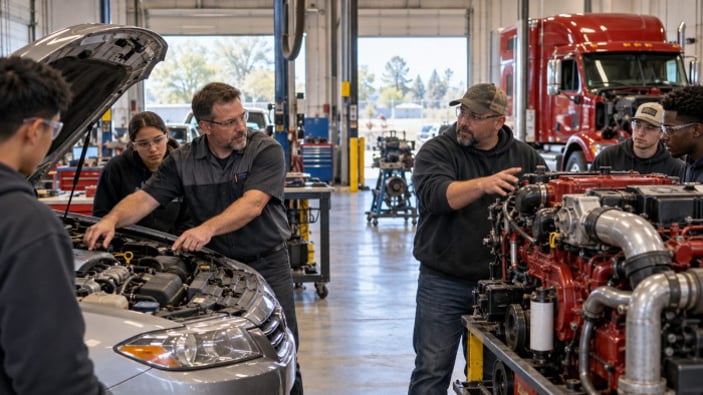
Automotive instructors teach light-vehicle service; diesel instructors teach medium- and heavy-duty truck and equipment service. Both lead hands-on transportation instruction, but national pay figures distinguish teaching settings rather than trades. BLS Occupational Employment and Wage Statistics (OEWS), May 2025, reports median annual pay of $66,270 for secondary CTE teachers; the postsecondary CTE teacher median is $63,820.
| BLS occupation covering both trades | National annual median | Source |
|---|---|---|
| Career/Technical Education Teachers, Secondary School | $66,270 | BLS OEWS, May 2025 |
| Career/Technical Education Teachers, Postsecondary | $63,820 | BLS OEWS, May 2025 |
Automotive instructor vs diesel instructor: the short answer
Your choice turns on the vehicles, service systems and industry relationships you want at the center of your teaching. Automotive instruction emphasizes light vehicles and relationships with dealerships and independent shops. Diesel instruction emphasizes trucks, equipment and relationships with fleets, trucking businesses and equipment employers.
BLS counts automotive and diesel instructors within Career/Technical Education Teachers, Secondary School and Career/Technical Education Teachers, Postsecondary. It does not publish a separate wage series for each trade. When comparing postings, separate the program of study from the teaching setting before drawing conclusions about pay.
Duties side by side
O*NET OnLine's secondary CTE teacher description and O*NET OnLine's postsecondary CTE teacher description (accessed October 26, 2026) identify lesson planning, demonstrations, equipment supervision and assessment as teaching duties. Apply that shared work to the service content of each career pathway.
| Teaching responsibility | Automotive application | Diesel application |
|---|---|---|
| Plan lessons and demonstrations | Brakes, steering and suspension, electrical systems, engine performance and light-vehicle service | Diesel engines, fuel systems, hydraulics, preventive maintenance and heavy-vehicle service |
| Supervise shop practice and enforce safety procedures | Demonstrate a light-vehicle procedure, then monitor students performing it | Demonstrate a truck or equipment procedure, then monitor students performing it |
| Assess projects and performance tasks | Evaluate the student's service process, explanation and completed work | Evaluate the student's maintenance or repair process, explanation and completed work |
| Connect lessons with employers and an advisory committee | Discuss service expectations with dealer and independent-shop partners | Discuss service expectations with fleet, trucking and equipment partners |
In either shop, explain how you teach students to justify a service decision and document the completed repair. Include the feedback you give when a student's diagnostic reasoning needs correction.
Use the automotive instructor duties guide to organize examples for an interview. Prepare a shop lesson, an assessment example and an explanation of how you intervene when practice becomes unsafe.
Shop, students and schedule
Either trade can place you with teenagers in a high school or career-center shop, or with adult and college students in a postsecondary lab. Ask how the assignment divides classroom instruction, demonstrations and supervised live work. For technical-college positions, confirm whether your teaching assignment includes day or evening sections.
O*NET reports standing in both occupations and distracting noise in secondary CTE teaching. Its duties also emphasize monitoring students' equipment use. During a shop visit, examine sightlines and how you would keep students under observation while demonstrating a procedure.
Compare the light-vehicle bay with the diesel assignment's vehicle size and heavier components. Ask whether instruction extends into a pit or yard and how students move between demonstration and practice areas.
Ask how student organization activities, contests and advisory committee meetings fit the schedule. Automotive employer contacts may center on dealers and independent shops; diesel contacts may center on trucking, fleets and equipment. In your interview, connect those relationships to work-based learning and examples students can practice in the shop.
Skills and tools compared
Instructing, speaking and monitoring matter when you explain a service procedure, observe student practice and correct an error. Equipment maintenance and troubleshooting matter when you prepare the lab and help students reason through a service problem. Your demonstration and assessment experience can apply to either trade; choose a light-vehicle or heavy-vehicle example that matches the posting.
For automotive instruction, explain how you would teach a light-vehicle electrical or engine-performance task. For diesel instruction, use a diesel fuel-system, hydraulics or preventive-maintenance task. Describe how you select equipment for the lesson, demonstrate its care and check student understanding.
O*NET lists Google Classroom, Moodle, Microsoft PowerPoint and Microsoft Excel for postsecondary CTE teachers. Connect software experience to an instructional purpose: organizing assignments, presenting a procedure or maintaining student records. The automotive instructor skills and software guide can help you shape that explanation.
For your résumé, pair light-vehicle or diesel service work with a shop demonstration, equipment-supervision task or performance assessment. Include only software you have used to support that instruction.
Pay compared
BLS OEWS May 2025 does not publish separate pay for automotive versus diesel instructors. These national percentiles describe the spread of annual pay across each broader CTE teaching occupation.
| BLS occupation | 10th percentile | 25th percentile | Median | 75th percentile | 90th percentile |
|---|---|---|---|---|---|
| Career/Technical Education Teachers, Secondary School | $50,040 | $60,590 | $66,270 | $80,060 | $101,340 |
| Career/Technical Education Teachers, Postsecondary | $41,960 | $50,320 | $63,820 | $82,360 | $108,620 |
State medians can change which setting pays more. Washington and Connecticut have higher secondary medians, while Wisconsin and South Carolina have higher postsecondary medians.
| State | Career/Technical Education Teachers, Secondary School: annual median | Career/Technical Education Teachers, Postsecondary: annual median |
|---|---|---|
| Washington | $101,180 | $77,530 |
| Connecticut | $100,810 | $59,420 |
| Massachusetts | $98,020 | $78,780 |
| Wisconsin | $74,310 | $82,620 |
| South Carolina | $72,120 | $79,610 |
| Texas | $64,610 | $65,180 |
Source: BLS OEWS, May 2025. Figures cover wage-and-salary workers and exclude self-employed workers.
Use the automotive instructor salary guide when comparing locations. For an actual posting, clarify the teaching assignment, shop responsibilities and schedule alongside the stated compensation.
Which fits you
Choose the technical content you can explain clearly and want to keep teaching: light vehicles, or heavy trucks and equipment. Then consider the employers you want on your advisory committee and the students you want to teach in a career-center shop or technical-college lab.
Present technician experience through safety, demonstrations, supervised live work and industry relationships. If you have supported student organization contests, explain how you prepared students and assessed their practice. Adapt these résumé examples only to work you have performed:
- Demonstrated [light-vehicle or diesel service procedure], monitored student practice and provided feedback on equipment care and work quality.
- Used input from [industry partners] to connect a shop project with workplace service expectations.
The automotive instructor résumé guide can help you develop those examples. Browse ACTE Job Bank openings with both the trade and teaching setting in mind, then match each application to the actual shop assignment.
Frequently asked questions
Which pays more, automotive instructor or diesel instructor?
BLS does not separate their pay. Its national annual medians are $66,270 for secondary CTE teachers and $63,820 for postsecondary CTE teachers, covering multiple trades.
What is the difference in the shop and the vehicles?
Automotive instruction centers on light vehicles; diesel instruction centers on medium- and heavy-duty trucks and equipment. Compare bay layout, heavier components and any pit or yard instruction when evaluating a diesel assignment.
Can I move from automotive instructor to diesel instructor?
Your lesson planning, demonstrations, shop supervision and performance assessment experience can support the move. Compare your technical experience with the posting's diesel engines, fuel systems, hydraulics and heavy-vehicle service duties.
Is the pay different at a career center versus a technical college?
BLS reports different medians by teaching setting: $66,270 nationally for secondary CTE teachers and $63,820 for postsecondary CTE teachers. Check the employer's setting and assignment because a career-center title alone does not establish the comparison.
Which fits someone coming from a dealership versus a truck shop?
Dealership experience aligns most directly with automotive service content, while truck-shop experience aligns most directly with diesel and heavy-vehicle service content. For either role, prepare a light-vehicle or truck-service example showing how you demonstrate a procedure, supervise practice and assess the student's work.