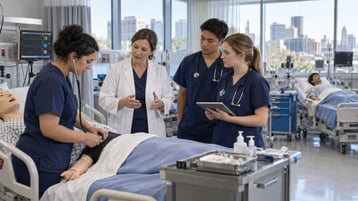
Ask every nursing instructor candidate the same job-related questions plus a skills-lab teaching demonstration. BLS Occupational Employment and Wage Statistics (OEWS), May 2025 counts Nursing Instructor within Nursing Instructors and Teachers, Postsecondary (SOC 25-1072), covering instructors who teach nursing in postsecondary classroom, skills-lab, and clinical settings. National employment is 77,960; the median annual wage is $80,250. Listen for how the candidate teaches patient care, runs a lab, and supervises students at clinical sites.
| Metric | Nursing Instructors and Teachers, Postsecondary (BLS) | Source |
|---|---|---|
| National employment | 77,960 | BLS OEWS, May 2025 |
| Median annual wage | $80,250 | BLS OEWS, May 2025 |
Nursing instructor interview questions: the short answer
Use one work sample plus the same job-related questions for every candidate, mapped to the O*NET OnLine tasks for SOC 25-1072 (accessed September 25, 2026). Those tasks include demonstrate and teach patient care, prepare lessons and course materials, evaluate laboratory and clinic work, supervise laboratory and clinical work, advise students on the program of study, and coordinate clinical learning with industry partners.
You are listening for four capabilities: teach patient care inside a nursing program of study; run a skills lab and simulation so students practice safely; supervise students at clinical sites with industry partners; and work with an advisory committee and a student organization. Put the work sample first so the panel sees instructing before it hears claims about instructing.
| What you are screening | Evidence in the room |
|---|---|
| Classroom and program of study | A week plan that mixes a classroom lesson, skills-lab practice, and a clinical day on one topic |
| Skills lab and simulation | Safety briefing, return demonstration, and a debrief with a next practice step |
| Clinical supervision | How they move among students and work with site staff when a student struggles |
| Partners and student organization | Advisory-committee use and how they treat rotations as work-based learning |
What the interview should cover
Build questions from O*NET duties, not from the last job title on the resume. Seat a panel of the program chair, a current nursing instructor, a skills-lab lead, and one industry-partner or advisory-committee voice when you can get them in the room. Give every panelist the same rubric: instructing, lab and clinical safety, assessment of hands-on skill, and work with industry partners.
O*NET lists evaluate and grade class, laboratory, and clinic work; supervise laboratory and clinical work; initiate and moderate classroom discussions; prepare and deliver lectures on topics such as pharmacology, mental health nursing, and community health care practices; prepare course materials such as syllabi, homework assignments, and handouts; demonstrate patient care in clinical units of hospitals; advise students on academic and vocational curricula and career issues; coordinate training programs with clinics, hospitals, health agencies, or vocational schools; and act as advisers to student organizations. Write those duties into your nursing instructor job description first, then ask how the candidate would teach, supervise, and give feedback. For the posting-to-first-weeks sequence around this question set, use how to hire a nursing instructor as the process companion.
Questions about classroom teaching and the program of study
Start with planning, not a teaching philosophy. A strong answer ties classroom, skills lab, and clinical time to the same unit in the program of study rather than to one-off lectures. Listen for the O*NET skills of learning strategies, instructing, and monitoring: how they choose a method, how they teach the skill, and how they watch performance and correct it.
| Ask | Listen for |
|---|---|
| Walk us through how you would plan a week that mixes a classroom lesson, a skills-lab practice, and a clinical day on the same topic. | One unit in the program of study, not three disconnected sessions; clear gates between lecture, lab, and clinical |
| How do you decide a student is ready to move from lab to clinical? | A performance task, not only a written test; what “ready” looks like on the skill |
| How do you revise a unit when students miss the same skill on a performance task? | They change the method of instruction and the lab practice, then reassess, rather than repeating the lecture |
| How do you advise a student who is passing written work but not performing the skill? | More lab time, a return demonstration, and a hold on the clinical day until the skill is safe |
| How do you prepare syllabi, assignments, and handouts so they stay aligned with the career pathway? | Course materials that match what partners expect in clinical, and use of a learning management system such as Moodle, Blackboard, or Sakai CLE |
Follow up on advising: how they keep that student in the program of study without sending an unprepared student to a clinical site. The same mix of lecture, lab, and supervised practice shows up in technical college instructor interview questions when a program of study moves students from classroom to shop or clinic. Ask how they would use Microsoft Word or Google Docs with colleagues to revise a unit after an advisory committee meeting; that surfaces collaboration without turning the hour into a software quiz.
Questions about skills lab, simulation and clinical teaching
Generic faculty lists skip this block. O*NET work context for this occupation shows face-to-face discussions every day for 70% of respondents, constant contact with others for 68%, and being exact or accurate as extremely important for 75%. Time pressure is weekly or more often for 48% of respondents. Health and safety of other workers is a very high responsibility for 51%, and 44% rate the consequence of error as extremely serious. Your questions should make the candidate talk about that setting: face-to-face teaching, being exact, time pressure, contact with others, and standing in lab and clinical units.
| Ask | Listen for |
|---|---|
| How do you brief safety before a skills-lab session? | A briefing students hear before they touch laboratory equipment; checks that the room and supplies match the skill |
| Tell us about a time a student was not safe with a patient or a procedure. What did you do? | They stopped the skill, protected the patient, coached the student, and decided whether that student returned to lab or clinical |
| How do you run a simulation debrief so students leave with a next practice step? | Specific feedback, a named skill to practice, and a plan for the next lab or clinical day |
| How do you work with clinical-site staff when a student is struggling? | They talk with the partner, adjust supervision, and do not leave the site staff to remediate alone |
| How do you demonstrate patient care in a clinical unit so students can then perform a return demonstration? | They treat laboratory equipment as teaching equipment, not only as gear they can operate themselves |
| How do you evaluate and grade laboratory and clinic work, not just papers and examinations? | A performance checklist, notes from the clinical day, and feedback the student can use in the next practice |
If the clinical partner uses medical software such as MEDITECH, ask how they would teach students to document in that system so lab practice matches the floor. A candidate who can perform a skill but cannot brief safety, check understanding, and run a return demonstration is not ready to instruct.
Questions about industry partners, advisory committees and work-based learning
Clinical rotations are work-based learning, not extra hours in a facility. Push past generic partnership talk and ask how the candidate would show up at the clinical site with students. A strong answer names how they share student performance with partners, invite partners into the lab, and keep clinical expectations matched to what was taught in lab.
| Ask | Listen for |
|---|---|
| How have you used an advisory committee to keep a nursing program of study aligned with current practice? | A unit they changed after partner input; supplies or skills they added to the lab |
| How do you treat clinical rotations as work-based learning rather than extra hours in a facility? | Objectives, supervision, and a debrief tied to the same skill taught in lab |
| How would you handle a clinical partner who is unhappy with student preparation? | They hear the partner, compare lab teaching to site expectations, and bring a fix back to the program of study |
| How do you coordinate clinical learning with hospitals, clinics, or health agencies? | How they schedule students, communicate with site staff, and stay on the unit with learners |
| How would you advise a student organization in this program? | Concrete support for the organization, not a claim that they “value student life” |
If you also staff a secondary health science pathway, adapt the lab and partner questions the way health science teacher interview questions treat skills-lab safety and industry partners. Keep the nursing panel focused on clinical-site behavior: who talks to the charge nurse, how students are paired, and what happens when a procedure does not go as planned.
Work sample to run with the interview
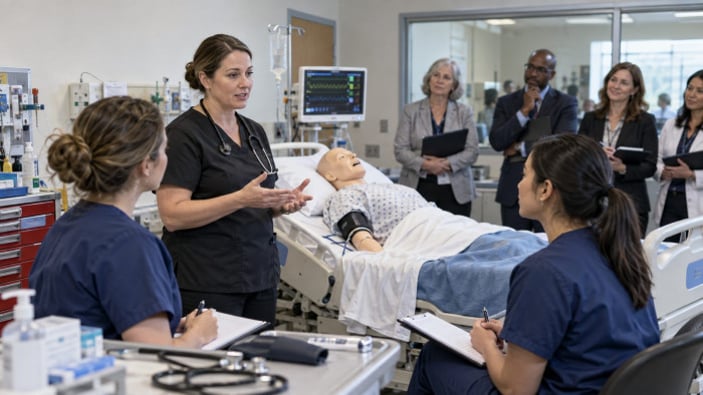
Run a 10–15 minute teaching demonstration of one nursing skill—vital signs, sterile technique, or a medication-administration walkthrough—delivered to the panel as if they were students. Require a safety briefing and a plan for supervising return demonstration in the skills lab. Score every candidate the same way.
| Score | What a strong demonstration shows |
|---|---|
| Clarity of the demonstration | Students could repeat the steps; the skill matches the program of study |
| Safety briefing | Hazards and expected behavior are named before anyone begins the skill |
| Checks for student understanding | Questions, a return demonstration, or a pause before the next step |
| Feedback | Specific, skill-based comments the learner can use on the next attempt |
| Plan for students who need more practice | Extra lab time and a clear gate before the clinical day |
Optional second sample: a short plan for one clinical day covering objectives, how students are paired, how the instructor moves among students, and how the day is debriefed. Use that sample when the vacancy is heavy on clinical supervision. Do not let a slide deck replace the demonstration; O*NET lists demonstrate patient care and supervise laboratory and clinical work as the work itself.
Running a fair interview and reading answers
Ask every candidate the same job-related questions in the same order. Take notes against instructing, lab and clinical safety, assessment of hands-on skill, and work with industry partners. After the panel, compare work-sample scores first, then interview notes. Call references about classroom and clinical teaching, lab safety, and reliability with clinical partners.
Under the laws enforced by the U.S. Equal Employment Opportunity Commission (accessed September 25, 2026), it is illegal to discriminate against an applicant because of race, color, religion, sex (including transgender status, sexual orientation, and pregnancy), national origin, age (40 or older), disability, or genetic information. Do not ask about age, family or pregnancy, religion, national origin, disability, genetic information, or other protected characteristics. Keep every question tied to teaching, supervision, and lab or clinical work.
If the candidate lists a license or professional credential, verify it with the body that issues it before the start date. Follow your district’s or college’s own clearance process. Use BLS figures as the market reference when you set the range; the wage spread for this occupation is in how much to pay a nursing instructor. When the posting is ready, post the opening and run every finalist through this same set. This guide is general information as of September 25, 2026, not legal advice.
FAQ
What should I ask a nursing instructor in an interview?
Ask every candidate the same job-related questions about planning a week that mixes classroom, skills lab, and clinical; lab and simulation safety; clinical supervision with industry partners; and work with an advisory committee and a student organization. Pair the questions with a 10–15 minute teaching demonstration. Map both to the O*NET tasks for Nursing Instructors and Teachers, Postsecondary.
How do I run a teaching demonstration for a nursing instructor?
Have the candidate teach one nursing skill (vital signs, sterile technique, or a medication-administration walkthrough) to the panel as if they were students, for 10–15 minutes. Require a safety briefing and a plan for supervising return demonstration in the skills lab. Score every candidate on clarity of the demonstration, the safety briefing, checks for student understanding, feedback, and a plan for students who need more practice.
What are good interview questions about clinical teaching?
Ask how they decide a student is ready to move from lab to clinical, how they work with clinical-site staff when a student is struggling, and how they treat clinical rotations as work-based learning. O*NET reports that 75% of respondents rate being exact or accurate as extremely important in this occupation. Listen for how they demonstrate patient care in clinical units and how they evaluate laboratory and clinic work.
How do I compare nursing instructor candidates fairly?
Ask every candidate the same job-related questions in the same order and score the work sample on the same rubric before you compare interview notes. Do not ask about race, color, religion, sex (including pregnancy, sexual orientation, and gender identity), national origin, age, disability, genetic information, or other protected characteristics. Call references about classroom and clinical teaching, lab safety, and reliability with clinical partners.
What work sample should I use for a nursing instructor?
Use a 10–15 minute teaching demonstration of one nursing skill, delivered to the panel as if they were students, including the safety briefing and how the instructor would supervise return demonstration. An optional second sample is a short plan for one clinical day covering objectives, how students are paired, how the instructor moves among students, and how the day is debriefed.