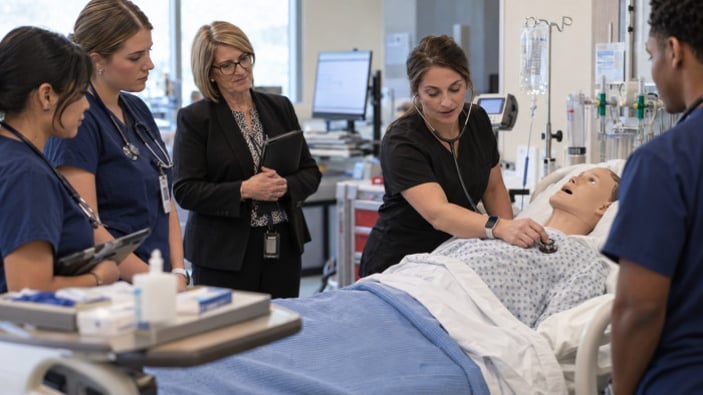
Hiring a nursing instructor means filling a dual role: a practicing expert in patient care who can also teach a nursing program of study in the classroom, skills lab and clinical sites. BLS counts this role within Nursing Instructors and Teachers, Postsecondary. BLS Occupational Employment and Wage Statistics (OEWS), May 2025 reports 77,960 of these instructors nationally, with a median annual wage of $80,250.
| Fact | Figure | Source |
|---|---|---|
| BLS occupation | Nursing Instructors and Teachers, Postsecondary (SOC 25-1072) | BLS OEWS, May 2025 |
| U.S. employment | 77,960 | BLS OEWS, May 2025 |
| Annual median wage | $80,250 | BLS OEWS, May 2025 |
| Annual 10th–90th percentile | $48,800–$129,500 | BLS OEWS, May 2025 |
How to hire a nursing instructor: the short answer
Define the job against your nursing program of study, set pay from the BLS figures for Nursing Instructors and Teachers, Postsecondary, and test real teaching in the classroom and skills lab before you make an offer. Then check references on student safety in lab and at clinical sites, and on reliability with industry partners.
This hire is not a staff-nurse search and not a generic faculty posting. The instructor must be both a practicing expert in patient care and a teacher of the nursing program of study, running a skills lab and simulation safely, supervising students at clinical sites with industry partners, tying lessons to bedside practice, and often advising a student organization and sitting with an advisory committee. Put that mix in the posting so candidates can see the real load.
What a nursing instructor does
According to O*NET OnLine (accessed September 25, 2026), nursing instructors demonstrate and teach patient care in classroom and clinical units. They prepare and deliver lessons on topics such as pharmacology, mental health nursing and community health care practices. They plan, evaluate and revise curricula, course content and methods of instruction, and they evaluate class work, laboratory and clinic work, assignments and papers.
They supervise students' laboratory and clinical work, advise students on academic and vocational curricula and on career issues, and coordinate training programs with clinics, hospitals, health agencies and vocational schools. Many maintain a clinical practice, serve on academic or administrative committees that deal with departmental and academic issues, and act as advisers to student organizations.
Technical colleges, community colleges, career centers and district programs that run a nursing program of study—including dual-enrollment sections—hire for this mix of classroom, skills lab or simulation, and clinical-site teaching. Write the opening for that three-setting job, not for a lecture hall. If the same campus also staffs a secondary health science pathway, the process for how to hire a health science teacher differs in setting even when both roles teach patient care.
Skills, knowledge and tools to look for
O*NET skills that show up in strong candidates are instructing, speaking, reading comprehension, active listening, learning strategies, writing, critical thinking, monitoring and complex problem solving. Listen for whether the person can teach a skill, watch a group of students practice it, and correct errors before anyone reaches a patient.
In conversation, knowledge of education and training, medicine and dentistry, psychology, biology, and therapy and counseling should sound like the ability to teach patient care, not like a list of course titles. Ask how they would explain a medication error, a mental-health assessment or a community-health visit to a first-term student, then how they would check that the student can do the work in the lab.
O*NET lists tools and technology that match this work: medical software such as MEDITECH; computer-based training software, including learning management systems, Moodle and Sakai CLE; Blackboard software; Microsoft Word, Excel, PowerPoint and Outlook; Google Docs; and iParadigms Turnitin. Comfort with those categories matters more than fluency in your exact build.
Treat as must-haves the ability to demonstrate a nursing skill, run a lab group safely, give feedback at the bedside or in simulation, and work with clinical partners. You can coach your LMS, your clinical-site calendar and your advisory-committee rhythm after the hire. Screen for the first set; plan onboarding for the second.
Setting the pay range
Use BLS as the market reference for Nursing Instructors and Teachers, Postsecondary—not staff-nurse wages and not secondary health science teacher wages. Nationally, the annual 10th percentile is $48,800, the 25th is $63,510, the median is $80,250, the 75th is $101,090 and the 90th is $129,500. The annual mean is $86,410. Those percentiles describe the spread of pay across the occupation.
| Percentile (annual) | Nursing Instructors and Teachers, Postsecondary (BLS) |
|---|---|
| 10th | $48,800 |
| 25th | $63,510 |
| Median | $80,250 |
| 75th | $101,090 |
| 90th | $129,500 |
Place the offer by experience and scope: number of clinical sections, skills-lab load, evening or weekend clinicals, and advisory-committee or student-organization duty. A location quotient above 1 means the occupation is more concentrated in that area's employment than nationally. Compare your state and metro with the tables here, then continue with how much to pay a nursing instructor when you lock the range.
| Rank | State | Employment | Annual median | Location quotient |
|---|---|---|---|---|
| 1 | Hawaii | 1,890 | $129,530 | 6.02 |
| 2 | District of Columbia | 110 | $107,770 | 0.32 |
| 3 | Delaware | 240 | $98,170 | 1 |
| 4 | Nevada | 870 | $96,500 | 1.11 |
| 5 | Connecticut | 1,380 | $95,500 | 1.63 |
| 6 | Idaho | 430 | $90,890 | 1 |
| 8 | Massachusetts | 2,280 | $85,130 | 1.25 |
| 9 | Texas | 6,830 | $84,930 | 0.97 |
| 10 | Wisconsin | 1,760 | $84,700 | 1.19 |
| 12 | New York | 6,340 | $82,950 | 1.3 |
Among major metro areas, employment is largest in New York-Newark-Jersey City, NY-NJ (5,290; annual median $92,050; location quotient 1.11). Houston-Pasadena-The Woodlands, TX shows an annual median of $103,010 (employment 1,580; location quotient 0.96). Milwaukee-Waukesha, WI has a location quotient of 2.02 (employment 830; annual median $84,700).
| Metro area | Employment | Annual median | Location quotient |
|---|---|---|---|
| New York-Newark-Jersey City, NY-NJ | 5,290 | $92,050 | 1.11 |
| Chicago-Naperville-Elgin, IL-IN | 3,840 | $80,440 | 1.7 |
| Los Angeles-Long Beach-Anaheim, CA | 2,350 | $79,680 | 0.75 |
| Philadelphia-Camden-Wilmington, PA-NJ-DE-MD | 2,050 | $81,040 | 1.41 |
| Houston-Pasadena-The Woodlands, TX | 1,580 | $103,010 | 0.96 |
| Boston-Cambridge-Newton, MA-NH | 1,560 | $83,550 | 1.15 |
| Phoenix-Mesa-Chandler, AZ | 1,420 | $71,740 | 1.2 |
| Dallas-Fort Worth-Arlington, TX | 1,180 | $98,970 | 0.58 |
Set a range from the BLS percentiles for your state and metro, then move the offer inside that range for lab load, clinical evenings and extra committee or student-organization duty. State that range in the posting so candidates can match themselves to the job.
Writing the posting and finding candidates
Title the job for the actual program of study and spell out the schedule: classroom days, skills-lab or simulation blocks, and clinical days with named industry partners. A nursing instructor job description template can hold those three settings in one posting so applicants are not guessing which part of the load is real.
State the term calendar, clinical sites, and any extra duties—student organization, advisory committee, work-based learning or clinical coordination—in plain language. Candidates who already precept or teach skills in a hospital lab can do this work; do not limit the search to people who already hold a faculty title.
Post where career and technical educators look, including the ACTE Job Bank. Use where to find nursing instructor candidates when you compare your metro with the larger markets above and decide how wide to recruit.
Screening and interviewing
Ask for a short teaching demonstration of one nursing skill—vital signs, sterile technique or a medication-administration walkthrough—delivered to the panel as if they were students. Require a safety briefing and a clear account of how the instructor would supervise practice in the skills lab before a student goes to clinical. Score the demo on accuracy, student safety, feedback and lab management, not on polish alone.
Build the rest of the interview around O*NET tasks: translating bedside experience into teaching; skills-lab and simulation safety and classroom management; assessing hands-on and clinical performance; working with clinical-site staff and the advisory committee; and arranging clinicals as work-based learning. Keep a set of nursing instructor interview questions and ask every candidate the same job-related questions.
Under the laws enforced by the U.S. Equal Employment Opportunity Commission (accessed September 25, 2026), it is illegal to discriminate because of race, color, religion, sex (including pregnancy, sexual orientation and gender identity), national origin, age, disability or genetic information. Do not ask about those characteristics. Keep every question tied to teaching patient care, running the lab and supervising clinicals.
References and the offer
Call references who have seen the candidate teach or precept. Ask about classroom and clinical teaching, student safety in the skills lab and at clinical sites, feedback to struggling students, and reliability with colleagues and clinical partners. Verify any license or credential the candidate lists with the body that issues it before the start date.
Put duties, schedule (including clinical days and evenings), program of study, lab and clinical load, and pay in writing. O*NET reports that 78% of respondents in this occupation work more than 40 hours a week, and 51% say they have very high responsibility for the health and safety of other workers; 44% say the consequence of error is extremely serious. Plan the first weeks around lab orientation, a walkthrough of each clinical site with the partner, and a first advisory-committee meeting so the new instructor is not learning those systems alone. This guide is general information as of September 25, 2026, not legal advice.
Frequently asked questions
What does a nursing instructor do?
A nursing instructor demonstrates and teaches patient care in the classroom, skills lab and clinical units; prepares lessons on topics such as pharmacology, mental health nursing and community health; evaluates class, laboratory and clinic work; supervises students; advises them on the program of study; and coordinates clinical learning with hospitals, clinics and other industry partners.
How much should I pay a nursing instructor?
BLS OEWS, May 2025, reports a national median annual wage of $80,250 for Nursing Instructors and Teachers, Postsecondary, with a 10th percentile of $48,800 and a 90th percentile of $129,500. Set your range from those figures and your state or metro row, then place the offer by clinical-section load, skills-lab duty and extra committee or student-organization work.
Can I hire a working nurse with no classroom teaching experience?
Yes, if the candidate can demonstrate a nursing skill, run a lab group safely, give feedback at the bedside or in simulation, and work with clinical partners. Precepting and skills-lab teaching count. You can coach your LMS, clinical-site calendar and advisory-committee rhythm after the hire.
How do I test a nursing instructor candidate before hiring?
Use a short teaching demonstration of one nursing skill, such as vital signs, sterile technique or a medication-administration walkthrough, delivered to the panel as if they were students. Require a safety briefing and an explanation of how the instructor would supervise skills-lab practice before a student goes to clinical.
What should I ask a nursing instructor in an interview?
Ask job-related questions about translating bedside experience into teaching, skills-lab and simulation safety, assessing hands-on and clinical performance, working with clinical-site staff and the advisory committee, and arranging clinicals as work-based learning. Ask every candidate the same questions. Do not ask about race, color, religion, sex, national origin, age, disability, genetic information or other protected characteristics.