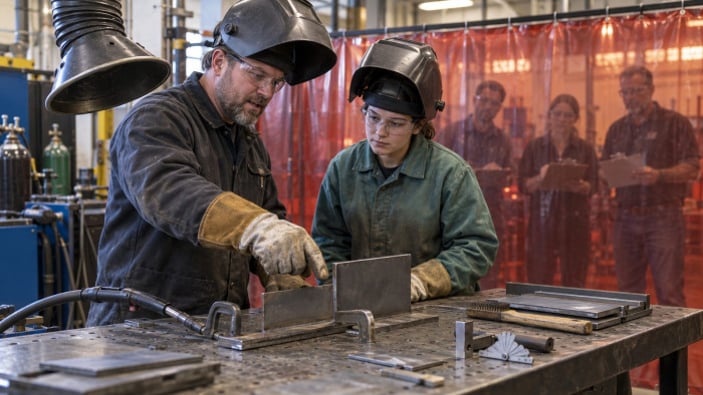
A resume cannot show whether a welding instructor can run a lab, coach a bead, and keep students safe. BLS Occupational Employment and Wage Statistics (OEWS), May 2025 counts Welding Instructor within Career/Technical Education Teachers, Postsecondary: 114,110 jobs and a median annual wage of $63,820. Screen with a technical check, a teaching demonstration, and a safety scenario, scored the same way for every candidate.
| Fact | Figure | Source |
|---|---|---|
| National employment | 114,110 | BLS OEWS, May 2025 |
| Median annual wage | $63,820 | BLS OEWS, May 2025 |
| Hourly median wage | $30.68 | BLS OEWS, May 2025 |
| Annual wage spread (10th to 90th percentile) | $41,960 to $108,620 | BLS OEWS, May 2025 |
What to screen welding instructor candidates for
O*NET OnLine lists Welding Instructor among sample job titles for SOC 25-1194.00 (accessed September 24, 2026). Daily work in that occupation includes instructing, monitoring student performance, supervising students’ use of tools and equipment, evaluating student work, and administering performance tests. Screen for the skills the job uses every day: instructing, quality control analysis, operation monitoring, and monitoring student performance.
A useful screen has three parts. Technical skill shows whether the candidate can set up welding power sources and torches and run cutting equipment such as plasma and oxy-fuel. Teaching skill shows whether they can explain a process, check for understanding, and coach a defect. Safety judgment shows how they would stop unsafe work and re-engage a student who has checked out of the lab.
Name those three parts in the posting so applicants know a work sample is required. Lock the tasks to your welding instructor job description before you invite anyone into the shop.
Technical skill check
Give every candidate the same coupon, process, and time limit on the equipment they would actually teach: welding power sources and torches, plus plasma or oxy-fuel cutting. Have them set up, run a specified joint, inspect their own work, and shut the booth down. If the candidate lists an industry credential, verify it with the body that issued it. That check sits beside the shop task; it does not replace it.
Watch setup first: machine settings, fit-up, polarity, and gas. Then watch travel speed, work angle, and whether they pause to look at the puddle. After the weld, they should name what they see—undercut, porosity, incomplete fusion, or a sound bead—before you say a word. Score setup, execution, self-inspection, and shutdown on a 1–4 scale. Do not score “years in the trade.” Score the work in front of you.
| Criterion | 1 – Does not meet | 2 – Partial | 3 – Meets | 4 – Strong |
|---|---|---|---|---|
| Setup | Wrong process or settings; skips fit-up | Correct process, incomplete setup | Settings, fit-up, and PPE match the task | Sets up cleanly and can explain each choice |
| Weld execution | Unstable puddle; stops without a plan | Bead present; travel or angle inconsistent | Controlled bead in the assigned process | Stable puddle; adjusts in real time |
| Self-inspection | Cannot name defects | Names a defect; no next step | Names defects and a correction | Inspects like a lab check: cause, fix, re-weld plan |
| Shutdown and booth | Leaves a live or cluttered booth | Powers down; leaves cables or coupons | Powers down and resets the station | Resets the booth to a teachable starting point |
Put the process, position, and time limit in the invitation so candidates still working in industry can prepare. The score is evidence for the offer, not a second interview.
Teaching demonstration
The work sample is a live weld in two positions plus a short demonstration of how the candidate would coach a student whose bead shows a common defect. O*NET tasks for this occupation include presenting lectures and discussions with visual aids, providing individualized instruction, observing and evaluating student work, and supervising laboratory work. Ask the candidate to teach the process, run both welds, then tutor the defect as if a student is at the next booth.
Score three things. Clarity: they name the joint, process, and what “good” looks like before striking an arc. Checking for understanding: they ask the student to restate the correction or try one pass while they watch. Pacing: they finish both positions without rushing the coaching. A whiteboard or O*NET-listed tools such as Microsoft PowerPoint are enough; do not score slide design.
| Teaching move | What to listen and watch for |
|---|---|
| Clarity | Process, position, and visual standard stated before the demo |
| Checking for understanding | Student restates or retries; instructor watches the retry |
| Pacing | Two positions completed; coaching is not cut short |
| Coaching the defect | Cause named, one correction given, next coupon assigned |
Use this score when you compare finalists. A strong fabricator who cannot teach the correction is not yet a program instructor.
Safety and classroom management judgment
Give a short scenario: a student does something unsafe, or a student disengages. Examples that stay inside the shop: a helmet lifted too soon, skipped PPE, walking into a live booth, or sitting out a lab after one bad bead. The candidate explains what they would do in the next two minutes, then in the rest of the period.
A strong answer stops the unsafe act immediately, resets the booth to your school’s own safety plan, tells the class why the stop happened, records what occurred, and gives a next step that puts the student back on a coupon with supervision. For disengagement, they notice it, check for understanding, and assign a short, observable task instead of sending the student to the hallway. Weak answers lecture about “attitude,” ignore the rest of the lab, or treat safety as optional once production starts.
O*NET work for this occupation includes supervising and monitoring students’ use of tools and equipment. Put that expectation in the first-week plan: the new hire walks the lab with your safety plan in hand and practices the stop-and-reset language before students arrive.
Building a fair scoring rubric
Use the same task, time limit, and rubric for every candidate. Print the 1–4 scale above, add the teaching and safety rows, and give each panel member a blank copy. Members score independently before they discuss. After scores are written, talk through gaps of two points or more. Average is not required; the written scores are the record.
Ask every candidate the same job-related questions. Under the laws enforced by the U.S. Equal Employment Opportunity Commission, it is illegal to discriminate because of race, color, religion, sex (including pregnancy, sexual orientation, and gender identity), national origin, age, disability, or genetic information (accessed September 24, 2026). Do not ask about age, family, pregnancy, religion, national origin, disability, genetic information, or other protected characteristics. If you require a test, EEOC states that the test must be necessary and related to the job. This guide is general information as of September 24, 2026, not legal advice.
Verify any license or credential the candidate lists with the body that issues it. Follow your district’s or college’s own clearance process. Keep the rubric in the file with the posting so a later panel can run the same screen.
Putting the screen into your hiring process
Run the hire in this order: application review, a short phone screen, the skills check plus demonstration, interview, then references. On the phone, confirm the candidate will complete a shop work sample; do not treat the call as the skills test. After the work sample, use the same welding instructor interview questions with every finalist. Career-center chairs who already screen auto labs can keep the same three-part structure used for screening automotive technology instructor candidates.
Part-time candidates who still work in industry take the same test. Change only the appointment time. Do not swap the live weld for a conversation about past jobs. When you set the offer, use the BLS figures as the market reference: median $63,820, with the 10th, 25th, 75th, and 90th percentiles at $41,960, $50,320, $82,360, and $108,620 (annual mean $72,060; hourly mean $34.64).
Place the opening on ACTE Job Bank once the work sample is written into the posting. The same three-part screen fits inside a full how to hire a welding instructor sequence from posting through the first weeks in the lab.
More hiring guides
FAQ
How do I test a welding instructor before hiring?
Run the same three-part screen for every candidate: a hands-on technical check on welding power sources, torches, and cutting equipment; a teaching demonstration with a live weld in two positions and coaching of a common bead defect; and a short safety or disengagement scenario. Score with one rubric before you interview.
What should a teaching demonstration include?
Ask for a live weld in two positions and a short demonstration of how the candidate would coach a student whose bead shows a common defect. Score clarity, checking for understanding, and pacing, not slide design.
How long should a skills test take?
Use one shop block with a posted time limit that covers setup, two welds, a short coaching demo, and a safety scenario. Apply the same clock to every candidate, including part-time applicants who still work in industry.
How do I score a hands-on test fairly?
Give every candidate the same coupon, process, time limit, and 1–4 rubric. Panel members score independently before they discuss. Ask only job-related questions.
Should part-time candidates take the same test?
Yes. Keep the same task and rubric; change only the appointment time so someone still working in industry can complete it.