An information technology teacher leads a secondary career pathway in networking, hardware, programming and cybersecurity, keeping lab machines and virtual environments running while students work. BLS counts this role within Career/Technical Education Teachers, Secondary School. National employment is 111,420 and the annual median wage is $66,270, according to BLS Occupational Employment and Wage Statistics (OEWS), May 2025. Define the program of study, set pay from those figures, test teaching and technical skill, then check references.
| Fact | Figure | Source |
|---|---|---|
| National employment | 111,420 | BLS OEWS, May 2025 |
| Annual median wage | $66,270 | BLS OEWS, May 2025 |
| Annual 10th–90th percentile | $50,040–$101,340 | BLS OEWS, May 2025 |
| BLS occupation | Career/Technical Education Teachers, Secondary School (SOC 25-2032) | BLS OEWS, May 2025 |
How to hire an information technology teacher: the short answer
Write the job as the program actually runs: which IT courses, which lab or shop, which student organization, and which industry partners sit on the advisory committee. Set pay from the BLS figures for SOC 25-2032. Screen with a work sample that pairs a short lesson with a hands-on lab. Call references about technical depth, teaching or training others, and dependability.
This hire is different from a standard academic post. The teacher covers networking, hardware, programming and cybersecurity for teenagers, keeps lab machines and virtual environments running, and tracks industry tools that move faster than a printed course outline. Hire for instructing plus shop-floor troubleshooting; train the LMS and local procedures after the start date.
What an information technology teacher does
According to O*NET OnLine (accessed September 24, 2026), secondary CTE teachers instruct students in the knowledge and skills of an occupational field through lectures, discussions, demonstrations and laboratory, shop and field studies. They monitor use and care of equipment, prepare materials and the classroom, evaluate performance, keep student records and stay current in the subject.
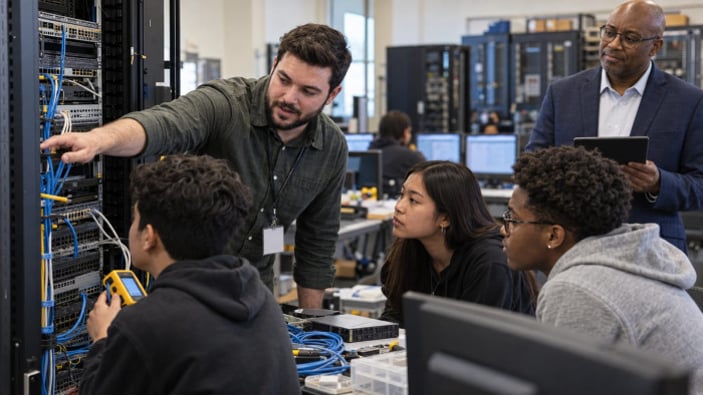
In an IT program of study, that occupational field is information technology. Day-to-day work includes teaching hardware, networking, programming and cybersecurity fundamentals; building and maintaining lab computers, network gear and virtual lab environments; preparing students for the industry skill assessments the program offers; and coaching cyber or coding competition teams. O*NET also lists sponsoring clubs, student organizations and academic contests; selecting, ordering and inventorying equipment; and planning work-experience programs in businesses and school laboratories.
Typical employers are high schools, career centers and technology academies. The same core teaching work appears when you hire a career and technical education teacher in another pathway; the difference here is a live student network and the pace of tool change. Name lab upkeep, contest coaching and industry-partner contact in the posting if those duties are real, so candidates self-select.
Skills, knowledge and tools to look for
O*NET lists Instructing, Learning Strategies, Critical Thinking and Systems Evaluation among the skills for this occupation, with Computers and Electronics as core knowledge and Working with Computers as a frequent work activity. Respondents also emphasize staying current in the subject and creating technology-based learning materials. For an IT teacher, that means explaining a technical idea to a first-year student, then walking the same student through a working lab exercise.
| Look for | What it looks like in this lab | Source |
|---|---|---|
| Instructing and learning strategies | A systematic mix of lecture, demonstration and laboratory work that beginners can follow | O*NET OnLine, 25-2032.00 |
| Computers and electronics knowledge | Hardware, networks, operating systems and software the pathway actually teaches | O*NET OnLine, 25-2032.00 |
| Critical thinking and systems evaluation | Diagnosing a failed lab, a misconfigured switch or a student virtual machine and restoring the class period | O*NET OnLine, 25-2032.00 |
| School-side software O*NET names | Learning management systems (including Blackboard Learn), Microsoft Office, Microsoft Outlook, Microsoft PowerPoint, Microsoft Excel, Google Docs, Kahoot! and Edpuzzle | O*NET OnLine, 25-2032.00 |
O*NET work-context responses describe a public, high-contact job: 90% use email every day, 82% report constant contact with others, 73% do public speaking every day and 80% work more than 40 hours in a typical week (accessed September 24, 2026). Treat lab rebuilds, contest coaching and advisory-committee nights as part of the load, not extras you mention after the offer.
Separate must-haves from what you can teach after hire. Technical command of the pathway, the ability to instruct beginners, and the judgment to keep students and equipment safe are hard to retrofit in the first term. District LMS use, local curriculum maps and how your advisory committee works can be trained. If the candidate comes from industry, plan a mentor for classroom routines; if the candidate comes from teaching another subject, plan time in the lab before students arrive.
Setting the pay range
Use BLS as the market reference for the broader secondary CTE teacher occupation, not as an exact rate for this IT specialty. Nationally, BLS reports an annual mean of $72,680 and this percentile spread:
| Percentile | Annual wage | Source |
|---|---|---|
| 10th | $50,040 | BLS OEWS, May 2025 |
| 25th | $60,590 | BLS OEWS, May 2025 |
| Median | $66,270 | BLS OEWS, May 2025 |
| 75th | $80,060 | BLS OEWS, May 2025 |
| 90th | $101,340 | BLS OEWS, May 2025 |
BLS publishes annual wages only for this occupation. Place the offer by your state figures, the candidate’s experience and the scope of lab, contest and work-based learning duties. The same BLS occupation is the reference in how much to pay a career and technical education teacher. A location quotient above 1 means the occupation is more concentrated in that area’s employment than nationally.
| Rank | State | Employment | Annual median | Location quotient |
|---|---|---|---|---|
| 1 | Washington | 3,460 | $101,180 | 1.36 |
| 2 | Connecticut | 1,910 | $100,810 | 1.57 |
| 3 | Massachusetts | 3,130 | $98,020 | 1.2 |
| 4 | New Jersey | 2,320 | $83,770 | 0.76 |
| 6 | California | 3,260 | $80,620 | 0.25 |
| 7 | New York | 7,610 | $79,820 | 1.1 |
| 9 | Ohio | 5,130 | $79,230 | 1.29 |
| 19 | Pennsylvania | 4,840 | $75,760 | 1.11 |
| 20 | Virginia | 3,500 | $75,580 | 1.19 |
| 27 | Texas | 32,250 | $64,610 | 3.2 |
| 32 | Florida | 6,820 | $62,140 | 0.96 |
| 35 | North Dakota | 640 | $61,500 | 2.08 |
| 38 | Idaho | 1,140 | $60,510 | 1.85 |
| 44 | Mississippi | 1,770 | $57,910 | 2.12 |
| 45 | West Virginia | 1,000 | $57,760 | 1.99 |
Read your own state row against the national median of $66,270. Texas shows both large employment (32,250) and a location quotient of 3.2. Put the range in the posting so IT practitioners can tell whether a move into the classroom is viable.
Writing the posting and finding candidates
Use a title that matches the program: Information Technology Teacher, Networking and Cybersecurity Teacher, or Computer Science and IT Teacher—whichever is accurate. List the courses, the lab setup, the bell schedule and extra duties (lab imaging, student organization, advisory committee, work-based learning visits) in plain language. State the setting: comprehensive high school, career center or technology academy.
Look beyond current teachers to experienced industry practitioners who can teach beginners and keep a student lab running. If the pathway sits beside engineering, the search overlaps with how to hire an engineering and technology teacher. Programs that place students in internships often pair this teacher with a work-based learning coordinator. Post where career and technical educators look, including on ACTE Job Bank.
Screening and interviewing
The work sample should mirror the job: a short lesson on one networking or security concept, plus a hands-on lab exercise the candidate designs and demonstrates. Give a fixed window, a student profile (first-year pathway students) and access to the same class of equipment they would use. Score technical accuracy, clarity for beginners and whether the lab would actually finish in one period. The same approach is used when screening CTE teacher candidates.
| Scorecard item | What a strong sample shows |
|---|---|
| Concept for beginners | One idea (for example a subnet or a basic access rule) explained without skipping steps |
| Hands-on lab | Students do the work; the teacher is not the only person at the keyboard |
| Lab and network judgment | Images, accounts or virtual machines reset cleanly for the next period |
| Curriculum currency | The candidate can say what they would change when an industry tool shifts |
| Safety and order | Clear rules for equipment, accounts and student behavior in the shop |
Ask every candidate the same job-related questions. Useful themes: IT industry experience; lab and network management; teaching technical concepts to beginners; keeping curriculum current; working with industry partners and the advisory committee; coaching a cyber or coding team. Sample questions: How would you teach this concept to a student who has never seen a command line? How do you keep lab machines usable between periods? How do you decide what to drop when a tool changes mid-year?
Under the laws enforced by the U.S. Equal Employment Opportunity Commission (accessed September 24, 2026), it is illegal to discriminate because of race, color, religion, sex (including transgender status, sexual orientation and pregnancy), national origin, age (40 or older), disability or genetic information. Do not ask about those subjects. If you use a test, it must be necessary and related to the job. This guide is general information as of September 24, 2026, not legal advice.
References, verification and the offer
Call references with a short, job-related list: technical depth in the pathway you teach, skill at teaching or training others, and dependability when a lab fails during a class period. Ask for examples, not adjectives.
Verify any degree, license or credential the candidate lists with the body that issued it before the start date. Follow your district’s or college’s own clearance process. Put duties, schedule, extra assignments and pay in writing so lab nights and contest travel are not a surprise in week three.
FAQ
What does an IT teacher do?
An information technology teacher instructs secondary students in an IT career pathway—typically hardware, networking, programming and cybersecurity—through lectures, demonstrations and laboratory work. Per O*NET, the broader CTE teacher occupation also maintains lab equipment, keeps student records and may sponsor student organizations and contests.
How much should I pay an IT teacher?
BLS reports an annual median of $66,270 for Career/Technical Education Teachers, Secondary School, with a 10th percentile of $50,040 and a 90th percentile of $101,340 (OEWS, May 2025). Use those figures as a market reference for the broader occupation and place your offer by state, experience and the scope of lab and extra duties.
Can I hire someone from industry with no teaching experience?
Yes, if they can teach the occupational skills and manage a student lab. O*NET respondents most often cited a bachelor’s degree (40%), and some cited a master’s (23%) or an associate’s degree (13%). Plan mentoring on classroom methods, grading and school procedures while you hire for technical depth.
How do I test an IT teacher candidate before hiring?
Use a work sample: a short lesson on one networking or security concept plus a hands-on lab the candidate designs and demonstrates. Score technical accuracy, clarity for beginners and whether the lab would actually run in your shop.
What should I ask an IT teacher in an interview?
Ask the same job-related questions of every candidate: how they teach a technical concept to first-year students, how they keep lab machines and virtual environments usable, how they update curriculum when industry tools change, and how they work with industry partners. Do not ask about age, family, religion, national origin, disability or other protected characteristics.