To hire an agriculture teacher, write the real program of study, set pay from BLS Occupational Employment and Wage Statistics (OEWS), May 2025 data for Career/Technical Education Teachers, Secondary School, run a work sample that tests teaching and supervised agricultural experience (SAE) planning, then check references. BLS counts this role within that occupation, which employed 111,420 wage-and-salary workers nationwide with a median annual wage of $66,270.
| Key fact | Figure | Source |
|---|---|---|
| National employment | 111,420 | BLS OEWS, May 2025 |
| Median annual wage | $66,270 | BLS OEWS, May 2025 |
| Annual wage spread (10th–90th percentile) | $50,040–$101,340 | BLS OEWS, May 2025 |
How to hire an agriculture teacher: the short answer
Define the pathway before you post. Name the courses, the greenhouse, land lab, animal facility or ag shop the teacher will run, SAE supervision, and FFA chapter advising, including evening and summer work. Set a pay range from the BLS figures for SOC 25-2032. Screen for classroom skill and technical skill with the same work sample for every finalist, then call references who have seen the candidate teach or lead youth.
This hire is not a standard classroom teacher. The person you want plans agriscience lessons and also keeps plants alive, equipment safe, animal projects on a calendar, and a student organization moving. Put that full load in the posting so the people who apply already know the job reaches past the bell.
What an agriculture teacher does
O*NET OnLine (accessed September 24, 2026) describes Career/Technical Education Teachers, Secondary School, including the sample title Agricultural Education Teacher. Core work is to instruct students in occupational knowledge and skills through lectures, discussions, demonstrations, and laboratory, shop, and field studies; to instruct and monitor students in the use and care of equipment; to plan and supervise work-experience programs in businesses, industrial shops, and school laboratories; and to sponsor extracurricular activities such as clubs and student organizations.
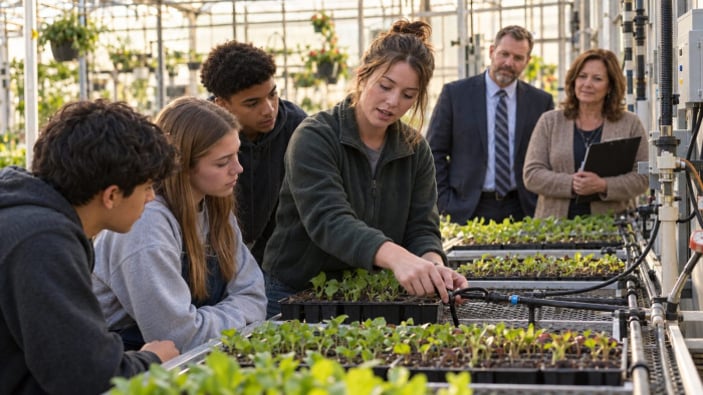
In an agriculture program of study that work looks like plant, animal and soil science, agricultural mechanics and agribusiness; day-to-day management of a school greenhouse, land lab, animal facilities or ag shop; SAE project visits; and advising an FFA chapter, including contest and event prep. Typical employers are rural and suburban high schools, middle schools and career centers. BLS counts this role within Career/Technical Education Teachers, Secondary School.
State evening, weekend, and facility-check duties in the posting. Use the agriculture teacher job description template and name the actual facilities.
Skills, knowledge and tools to look for
From O*NET, treat instructing, coordination, monitoring of student performance, and management of material resources as the skills that separate a workable hire from a weak one. The teacher must teach others how to do something, keep a group moving in a shop or greenhouse, watch student work before someone is hurt or a project fails, and inventory equipment, seed, feed and supplies.
O*NET technology includes Microsoft Office, Google Docs, learning management systems, and Autodesk AutoCAD Civil 3D. Name the software, greenhouse or land-lab equipment, and mechanics tools the program actually uses.
Must-haves on day one: safe supervision of students around equipment and animals, enough content breadth to teach the courses you actually run, and a working plan for SAE visits and FFA advising. You can train LMS routines, your gradebook, advisory-committee habits and local industry-partner names after the start date. Score those two piles separately so you do not reject a strong industry practitioner for not knowing your hall-pass rules, and so you do not hire a polished classroom presence who cannot run the shop.
Setting the pay range
Use BLS as the market reference. For Career/Technical Education Teachers, Secondary School, the national annual mean is $72,680. Across the occupation, annual wages run $50,040 at the 10th percentile, $60,590 at the 25th, $66,270 at the median, $80,060 at the 75th and $101,340 at the 90th. Use the published annual wages for this occupation. Treat the figures as a reference point for agriculture teaching, not an exact rate for this specialty.
| Percentile | Annual wage (U.S.) |
|---|---|
| 10th | $50,040 |
| 25th | $60,590 |
| Median | $66,270 |
| 75th | $80,060 |
| 90th | $101,340 |
Place the offer by your state figures, the candidate’s experience, and the scope of lab, SAE and FFA duties. A location quotient above 1 means the occupation is more concentrated in that area’s employment than nationally. Texas employment is 32,250 with a location quotient of 3.2 and an annual median of $64,610. Washington’s annual median is $101,180 (employment 3,460, location quotient 1.36). Compare your state with the national median of $66,270 rather than averaging rows.
| Rank | State | Employment | Annual median | Location quotient |
|---|---|---|---|---|
| 1 | Washington | 3,460 | $101,180 | 1.36 |
| 2 | Connecticut | 1,910 | $100,810 | 1.57 |
| 7 | New York | 7,610 | $79,820 | 1.1 |
| 9 | Ohio | 5,130 | $79,230 | 1.29 |
| 27 | Texas | 32,250 | $64,610 | 3.2 |
If your opening includes summer greenhouse work, livestock checks or a heavy FFA calendar, say so in the offer letter and set the range using the same BLS spread you would use for other secondary CTE teachers. Statewide pay context for the broader occupation is in how to hire a career and technical education teacher.
Writing the posting and finding candidates
Title the job for the program you run: agriculture teacher, agricultural education teacher, or the pathway name students see on the course guide. List courses, the facility, SAE visit expectations, FFA advising, and the weekly and seasonal schedule. State evening, weekend and summer duties in plain language so applicants can decide before they apply.
Look past sitting teachers. Experienced growers, mechanics, agribusiness staff and extension educators often have relevant shop and field skill. O*NET places this occupation in Job Zone Four; respondents said a bachelor’s degree is required (40%), a master’s (23%), or an associate’s or other two-year degree (13%). Screen industry candidates for instructing skill, not for whether they already know your bell schedule.
Post where career and technical educators look, including the ACTE Job Bank. Name industry partners, the advisory committee, and work-based learning in the posting only when those are real parts of the job. A construction shop hire follows a similar lab-plus-classroom pattern in how to hire a construction trades teacher; keep agriculture-specific language for SAE, the land lab and the FFA chapter.
Screening and interviewing
Use the same work sample for every finalist: a short lesson from an agriscience unit (plant science, animal science, soil, mechanics or agribusiness) plus a discussion of how the candidate would plan a schedule of SAE visits. Watch how they set a demonstration, talk about equipment care, and map visits across a calendar that already includes FFA events and facility chores.
| Work-sample part | What you score |
|---|---|
| Agriscience lesson | Accurate content, clear objective, safe demo, student checks for understanding |
| SAE visit plan | Realistic calendar, mix of project types, record-keeping, parent and employer contact |
| Facility scenario (greenhouse, shop or animal space) | Student supervision, equipment care, inventory, their initial priorities |
Interview themes: breadth across plant, animal and mechanics content; facility and project management; student organization and community work; and schedules beyond the school day. Ask every candidate the same job-related questions. Ready-to-use prompts are in the agriculture teacher interview questions guide.
Under the laws enforced by the U.S. Equal Employment Opportunity Commission (accessed September 24, 2026), it is illegal to discriminate because of race, color, religion, sex (including transgender status, sexual orientation, and pregnancy), national origin, age (40 or older), disability or genetic information. Do not ask about age, family or pregnancy, religion, national origin, disability, genetic information or other protected characteristics. Keep questions on courses, labs, SAE, FFA advising and community partners. This guide is general information as of September 24, 2026, not legal advice.
References, verification and the offer
Call references who watched the candidate teach, coach a student organization or run a shop, greenhouse or herd. Ask about organization, student safety, follow-through on visits and projects, and working relationships with families, employers and an advisory committee. Stay on job performance.
Verify any degree, license or credential the candidate lists with the body that issued it, and follow your district’s or college’s own clearance process, before the start date. State the schedule, facility responsibility, SAE and FFA work, and pay in writing so the hire starts with clear expectations.
More hiring guides
Frequently asked questions
What does an agriculture teacher do?
An agriculture teacher teaches plant, animal and soil science, agricultural mechanics and agribusiness; manages a greenhouse, land lab, animal facility or ag shop; supervises SAE projects; and advises an FFA chapter. BLS counts the role within Career/Technical Education Teachers, Secondary School, which employed 111,420 wage-and-salary workers as of May 2025.
How much should I pay an agriculture teacher?
Use the BLS median of $66,270 as the national market reference for Career/Technical Education Teachers, Secondary School, and place your offer using your state’s median and the scope of lab, SAE and FFA duties. National annual wages run from $50,040 at the 10th percentile to $101,340 at the 90th.
Can an industry practitioner be an agriculture teacher candidate?
Consider industry practitioners with technical depth in plant, animal, or mechanics work and evidence they can teach others safely. O*NET reports that 40% of respondents in this occupation said a bachelor’s degree is required, 23% a master’s, and 13% an associate’s or other two-year degree.
How do I test an agriculture teacher candidate before hiring?
Ask for a short lesson from an agriscience unit plus a discussion of how the candidate would plan a schedule of SAE visits. Score the same work sample for every candidate on content accuracy, shop or greenhouse safety, and a realistic visit calendar.
What should I ask an agriculture teacher in an interview?
Ask the same job-related questions of every candidate about plant, animal and mechanics content, facility and project management, student organization and community work, and work beyond the school day. Do not ask about age, family or pregnancy, religion, national origin, disability, genetic information or other characteristics protected under EEOC rules.