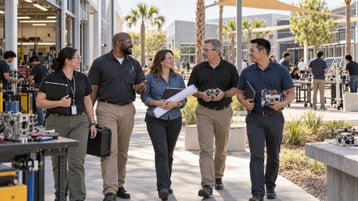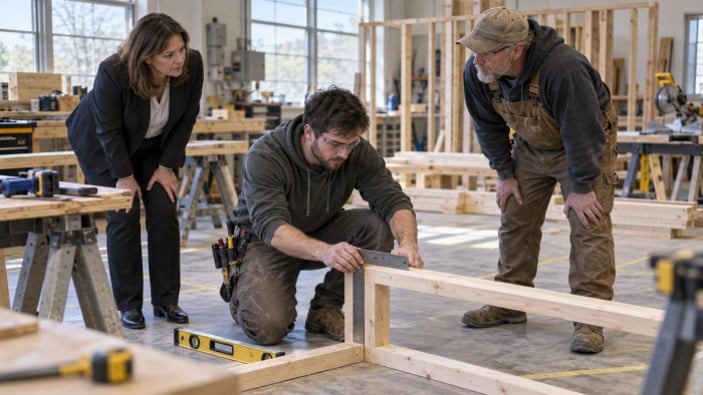
A construction trades teacher runs a shop, teaches an architecture-and-construction career pathway, and keeps secondary students safe around equipment. BLS counts this role within Career/Technical Education Teachers, Secondary School: 111,420 wage-and-salary jobs and a median annual wage of $66,270, per BLS Occupational Employment and Wage Statistics (OEWS), May 2025. The questions below test trades skill, shop supervision, and work-based learning together.
| Fact (Career/Technical Education Teachers, Secondary School; BLS includes construction trades teachers) | Figure | Source |
|---|---|---|
| U.S. employment | 111,420 | BLS OEWS, May 2025 |
| Annual median wage | $66,270 | BLS OEWS, May 2025 |
| Annual mean wage | $72,680 | BLS OEWS, May 2025 |
| Annual wage spread (10th / 25th / 75th / 90th percentile) | $50,040 / $60,590 / $80,060 / $101,340 | BLS OEWS, May 2025 |
How to use these construction trades teacher interview questions
Pick 8–12 questions from the sections below and ask each candidate the same set, in the same order. Score answers against what a strong answer shows—sequence, safety, and pathway ties—not against a long job-site story. Use the BLS median of $66,270 as the market reference when you set the range on the posting and the offer.
Ask only job-related questions. Do not ask about age, family or pregnancy, religion, national origin, disability, genetic information, or other characteristics protected under the EEOC prohibited employment policies page. If the job requires standing a shop period, lifting materials, or working an outdoor community build, ask that duty of everyone in the same words.
A panel that already ran a general career and technical education teacher interview can swap in these shop and pathway items. When the score sheet is set, post the opening so raters and applicants see the same role.
| Step | What to do |
|---|---|
| Before the panel | Choose 8–12 questions and give every rater the same score sheet. |
| Work sample | Run one short teaching demonstration with the same rubric for every finalist. |
Put the selected questions and the demo prompt in the hiring packet so every rater is scoring the same job. Pair this list with the steps in how to hire a construction trades teacher before you go live.
Questions about trades experience and how it translates to teaching
O*NET OnLine (accessed September 25, 2026) lists instructing students individually and in groups, using lectures, discussions, and demonstrations, in a career/technical subject. For this hire, that subject is a construction career pathway—carpentry, electrical, plumbing, masonry, or a multi-trade program of study. A strong journeyman is not automatically a teacher of teenagers in a career center or high-school shop.
| Ask | A strong answer shows |
|---|---|
| Walk us through how you would turn reading a print into a lesson for secondary students. What do they do first, and how do they get to a cut list? | A sequence students can follow, trade language tied to the tools on the benches, and a check that layout is square before anyone cuts. |
| Take laying out a wall, cutting a joint, or sequencing a small build. How would you instruct a mixed-skill class so some students get a demonstration while others work a station? | Individuals and groups both have work. The candidate is teaching, not only performing the trade in front of the class. |
Questions about shop safety and tool supervision
O*NET tasks for this occupation include instructing and monitoring students in the use and care of equipment and materials to prevent injury and damage, and establishing and enforcing rules for behavior and procedures. The work also includes coordinating and leading others and carrying responsibility for other people’s health and safety. In a construction shop that means saws, power nailers, scaffolds, levels, and hand tools—not a lecture hall.
| Ask | A strong answer shows |
|---|---|
| How do you brief a class before tools come out so every student hears the same rules for saws, power nailers, scaffolds, and hand tools? | A pre-lab briefing every student hears, including guards and hearing protection, before anyone approaches a station. |
| How do you stage stations so no student works a saw unsupervised while you are at another bench? | Eyes on every station: a physical layout and a hold rule, not “I will hear if something is wrong.” |
If a candidate talks only about “being careful,” ask them to walk the panel through the first minutes of a lab. Related shop-heavy hires, such as those in how to hire a welding instructor, fail for the same reason: unsupervised power equipment. Write the briefing and station-staging expectations into the posting so applicants know the job is shop teaching, not solo production work.
Questions about lesson planning and assessment of hands-on skills
O*NET skills for the occupation include instructing, speaking, learning strategies, active listening, and monitoring. Tasks include establishing clear objectives for lessons, units, and projects; adapting methods to students’ needs and interests; observing and evaluating performance; and preparing, administering, and grading tests and assignments. In construction, the product and the process both count.
| Ask | A strong answer shows |
|---|---|
| How do you plan a project-based unit—a shed wall, a mock-up, or a community-build piece—so students see the objectives before they pick up materials? | Objectives students can see: layout, square, cut quality, print reading—not only a picture of the finished piece. |
| How do you assess both the product and the process? | Checkpoints before power tools. Feedback that names the next skill, not only a grade on the finished piece. |
Questions about employer partnerships and work-based learning
O*NET tasks include planning field trips, visits by guest speakers, and other experiential activities; planning and supervising work-experience programs in businesses, industrial shops, and school laboratories; placing students in jobs or making referrals; and collaborating with other teachers and administrators on secondary programs. For construction, that work runs through contractors, builders, and an advisory committee for the program of study.
| Ask | A strong answer shows |
|---|---|
| How would you plan a field trip or guest speaker with a contractor or builder so students leave with job-site expectations they can practice in the shop the next day? | A specific partner role—superintendent walk-through, layout lead, safety talk—and a shop task that follows. |
| How would you place students in work-based learning, and how would you prepare them for a site visit or a placement day? | Preparation for who they report to and what they may not touch, plus a debrief that changes the next shop period. |
Listen for partner roles, not a claim that “the community supports CTE.” The same partnership logic shows up when you hire a career and technical education teacher in any pathway; for construction, the test is whether last month’s advisory note shows up in this month’s wall layout.
Questions about student organizations, parents and community builds
O*NET includes sponsoring extracurricular activities such as clubs and student organizations, and conferring with parents or guardians about progress and priorities. Construction teachers often carry a student organization and service or competition builds on top of the shop day, plus parent contact about off-campus work-based learning.
| Ask | A strong answer shows |
|---|---|
| How would you sponsor a construction student organization so a competition or service build teaches the pathway? | Student-organization work that teaches layout, safety, and teamwork on a real build, not extra hours with no skill target. |
| How would you confer with parents or guardians about progress in a shop course and about work-based learning days off campus? | Contact about skill and safety—this joint, this placement-day attendance—not a pitch for the program. |
Pair the interview with a work sample
Have each finalist deliver a short teaching demonstration of one hands-on construction skill—laying out a wall, cutting a joint, or reading a print to a cut list—to the panel as if the panel were secondary students. The demo must include the shop safety briefing that would precede tools coming out. Score every candidate with the same rubric.
| Criterion | What to look for |
|---|---|
| Sequence | Students could follow the steps without guessing the next layout mark or cut. |
| Safety talk | A pre-lab briefing every student would hear before tools come out, including guards and hearing protection. |
| Check for understanding | The candidate asks students to repeat a step or show a mark before power equipment. |
| Transfer | The panel could attempt the skill after the demo. |
Run the demo in the actual shop if you can. A conference-room talk about a joint is not the job you are filling. Use the same four scores when you compare finalists; do not add a fifth “fit” box that is not on the sheet.
Questions to avoid
Under the laws enforced by the EEOC (accessed September 25, 2026), it is illegal to discriminate against an applicant because of race, color, religion, sex (including transgender status, sexual orientation, and pregnancy), national origin, age (40 or older), disability, or genetic information. Do not ask about family plans, worship, country of origin, health, or age. Keep every question tied to shop teaching, safety, and pathway duties.
You may ask whether the candidate can meet stated job duties—standing a shop period, lifting materials, working an outdoor community build—if you ask that question of everyone in the same words and it matches the work. If the candidate lists a license or professional credential, verify it directly with the body that issues it before the start date. This guide is general information as of September 25, 2026, not legal advice.
FAQ
What are good interview questions for a construction trades teacher?
Ask how the candidate turns a job-site task into a secondary lesson, how they brief and supervise a shop, how they assess layout and cut quality, how they work with industry partners and an advisory committee, and how they sponsor a student organization and confer with parents.
Should I add a shop demonstration or work sample?
Yes. Have the candidate teach one hands-on skill—laying out a wall, cutting a joint, or reading a print to a cut list—to the panel as if they were secondary students, including the shop safety briefing.
What questions should I avoid in the interview?
Do not ask about race, color, religion, sex (including pregnancy, sexual orientation, and gender identity), national origin, age, disability, or genetic information, which the EEOC lists as protected characteristics.